Signal-Based Triage Queue
Prioritize the annotation queue by a per-item quality signal so reviewers see the worst or most-suspect traces first, instead of annotating in arrival order. Route by agent errors, production thumbs-down, low scores, or any custom field.
The triage queue prioritizes annotation by a per-item quality signal, so reviewers see the worst or most-suspect items first instead of working in arrival (FIFO) order. The signal can be an agent error, a production thumbs-down, a low automated score, or any custom field. It is read for both statically loaded data and traces ingested at runtime, and it surfaces in two places: a banner during annotation and the /admin/triage-queue ranking page.
When human review time is scarce, the order in which items reach annotators matters. Routing the most informative items first is the triage half of an active evaluation loop, and it pairs naturally with Judge Alignment to send disagreements and errors to people first.
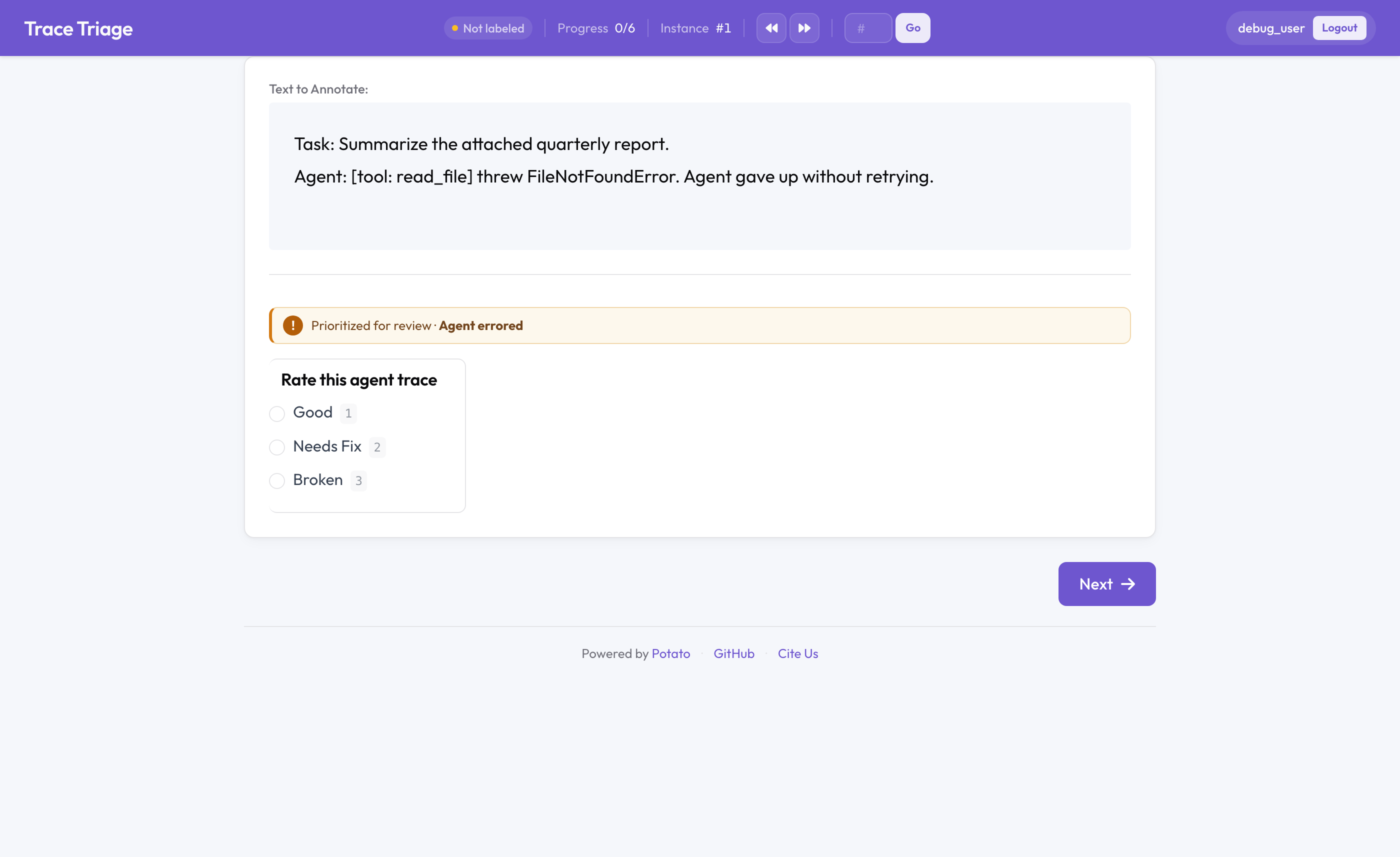 A priority badge explaining why an item was flagged for review
Configuration
triage:
  enabled: true
  order: desc            # high priority first (default); 'asc' = low first
  default_priority: 0    # items matching no rule
  show_badge: true       # banner during annotation explaining the priority
  rules:                 # evaluated in order; highest matching priority wins
    - name: "Agent errored"
      badge: "Agent errored"     # banner text (defaults to name)
      priority: 100
      when:
        field: status            # dotted paths allowed, e.g. metadata.tags
        equals: error
    - name: "Negative feedback"
      priority: 80
      when:
        field: feedback
        in: [thumbs_down, negative]
    - name: "Low quality score"
      priority: 60
      when:
        field: score
        lt: 0.5

# Serve the highest-priority items first. If you enable triage without setting
# assignment_strategy, Potato defaults to `priority` automatically.
assignment_strategy: priority
If you omit rules (and signal_field), Potato uses a turnkey default set: error status (100), negative feedback (80), and score below 0.5 (60).
Condition operators
| Operator | Meaning |
|---|---|
equals | exact match (strings are case-insensitive) |
in | value is one of a list |
contains | list field contains, or substring match |
lt / lte / gt / gte | numeric comparison |
exists | field is present or absent (true/false) |
Reading a numeric signal directly
Instead of, or in addition to, rules, you can read a number straight from a field:
triage:
  enabled: true
  signal_field: quality_score   # used as the priority when no rule matches
  invert_signal: true           # lower score => higher priority
How priority drives assignment
Set assignment_strategy: priority. When a user needs items, the queue is sorted by each item's stored triage_priority (descending by default; order: asc flips it), with ties broken by the original load order for determinism, and the top items are assigned. The signal is computed once at load or ingestion time and stored on the item, so assignment stays cheap.
The badge (show_badge: true) is independent of the strategy. It explains why an item was flagged even if you keep a different assignment strategy.
The admin queue page
GET /admin/triage-queue              # JSON
GET /admin/triage-queue?format=html  # rendered page
Send the X-API-Key header. The page shows every remaining (incomplete) item ranked by priority, with the rule that flagged it, the current annotation count, and whether it is already assigned.
Runtime ingestion
Because the scorer runs as items are added, traces ingested at runtime through trace ingestion (the webhook endpoint or a Langfuse poller) are scored as they arrive and slot into the priority queue automatically. A low-scoring or errored trace pushed in mid-session jumps ahead of clean ones still waiting.
Notes and limitations
- Priority is computed at insertion time. Editing
triage.rulesand restarting re-scores everything on the next load. - A malformed rule logs a warning and is skipped; it never blocks data loading.
- Triage orders which items are served. It does not change per-item annotation caps.
Related
- Judge ↔ Human Alignment — quantify judge/human agreement
- Three-Pane Trace Evaluation — read incoming traces quickly
- Agentic Annotation — trace ingestion and display
For implementation details, see the source documentation.