Boundary Lab
Probe the decision boundary, not just the point. After each label, Potato asks whether a minimal counterfactual edit would change it — producing contrast sets and quality control from ordinary annotation.
New in v2.7.0
Every annotation tool collects point labels: item X gets label Y. Boundary Lab makes Potato collect decision boundaries. The moment an annotator commits a label, Potato shows minimal counterfactual edits of the text and asks, one probe at a time:
You said Polite. Would that survive this edit?
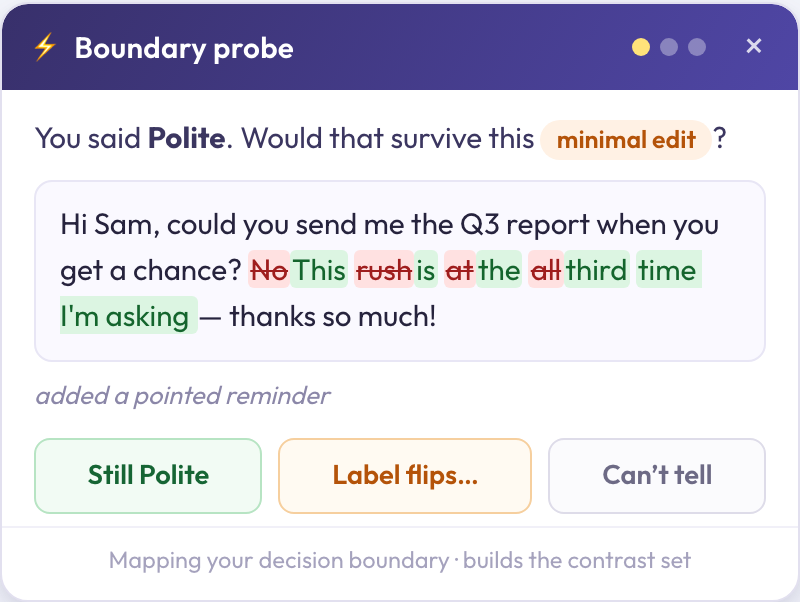
Each answer takes one click. Ordinary annotation then produces three artifacts that a plain label export cannot.
- Contrast sets, for free. Every answered probe is a labeled (original, counterfactual) pair. Perturbing an instance so that its gold label changes is the contrast set method of Gardner et al. 2020, and training on original and revised versions of the same item is counterfactually-augmented data, which Kaushik et al. 2020 found leaves classifiers less sensitive to spurious features. Building either one is normally a separate and expensive annotation effort.
- Boundary rationales. When a label flips, the annotator says what crossed the line. These rationales pinpoint where your codebook is ambiguous.
- Invisible quality control. Invariance probes are meaning-preserving paraphrases, and a consistent annotator never flips on them. Annotators who do are flagged on the dashboard, which gives you an attention signal without planting a single fake gold item.
Configuration
boundary_probing:
  enabled: true
  schema: politeness          # scheme to probe (default: first radio scheme)
  probes_per_item: 3          # probes per (instance, label), invariance included
  include_invariance: true    # add one paraphrase probe (the QC signal)
  sources:                    # probe generation tiers, in priority order
    - precomputed
    - llm
    - rules
  precomputed_key: counterfactuals   # item-data field for precomputed probes
  rationale_on_flip: true     # ask "what crossed the line?" when a label flips
  debounce_ms: 900            # delay between label selection and probe fetch
Probe sources
Probes come from three tiers. Later tiers fill slots that earlier tiers leave empty, so the feature degrades gracefully.
precomputed — ship curated counterfactuals with your data. Deterministic, and ideal for controlled studies:
{"id": "req_02", "text": "Send me the slides before the meeting.",
 "counterfactuals": [
   {"text": "Please send me the slides before the meeting.", "kind": "flip",
    "edit_hint": "added \"please\""},
   {"text": "Before the meeting, send me the slides.", "kind": "invariance",
    "edit_hint": "reordered clauses"}
 ]}
llm — generate probes on the fly with any configured AI endpoint (Anthropic, OpenAI, Ollama, vLLM). Probes are generated once per (instance, label) and shared across annotators, so LLM cost is bounded by dataset size rather than annotator count.
rules — deterministic lexical transforms: negation toggles, intensifier swaps, politeness markers, punctuation heat, and contraction or greeting paraphrases for invariance. No dependencies and no model calls, which is what lets Boundary Lab run with no LLM configured at all.
Probe kinds and verdicts
| Kind | Meaning | Expected behavior |
|---|---|---|
flip | Smallest edit intended to cross the label boundary | May flip or hold — both are informative |
invariance | Meaning-preserving paraphrase | Should never flip; flips indicate inconsistency |
Annotators answer each probe with holds (the label survives), flips (the label changes, and they pick the new one and optionally say why), or can't tell.
The dashboard
At /boundary/dashboard (admin access):
- Boundary sensitivity by label — of the minimal edits aimed at each label, the share that flipped. A 90% flip rate means the label lives on a knife's edge; 10% means it is robust to small perturbations.
- Annotator invariance consistency — per-annotator hold rate on paraphrase probes, flagged red below 60%.
- Where labels flip — a gallery of confirmed flips with word-level diffs and the annotators' rationales.
Contrast-set export
GET /boundary/api/export (admin) downloads JSONL, one labeled pair per answered probe:
{"instance_id": "req_02", "schema": "politeness",
 "original_text": "Send me the slides before the meeting.",
 "original_label": "Impolite",
 "counterfactual_text": "Please send me the slides before the meeting.",
 "counterfactual_label": "Neutral",
 "kind": "flip", "flipped": true,
 "rationale": "please softens the command",
 "edit_hint": "added \"please\"", "probe_source": "precomputed",
 "annotator": "alice", "timestamp": 1783827299.4}
holds verdicts export with counterfactual_label equal to the original label, which makes them useful as hard negatives. unsure verdicts are excluded.
Design notes
- Probes are cached per (instance, schema, label) and shared across annotators, so invariance consistency is comparable between annotators.
- The probe panel is an overlay. It never blocks the main annotation flow, probe answers are optional, and annotators can dismiss it at any time.
- Probing currently targets one single-choice (
radio) scheme per task.
Further reading
- Truth Serum — the other no-gold-label quality signal
- Quality control — attention checks and gold standards
- Gold standards and attention checks
- Source documentation