Multirate (Matrix Rating)
Configure a rating matrix in Potato where annotators score multiple items on the same scale simultaneously — useful for comparative evaluation and rubric-based tasks.
The multirate type displays multiple items in a matrix format where each item is rated on the same scale. Use it to evaluate several dimensions of a single item.
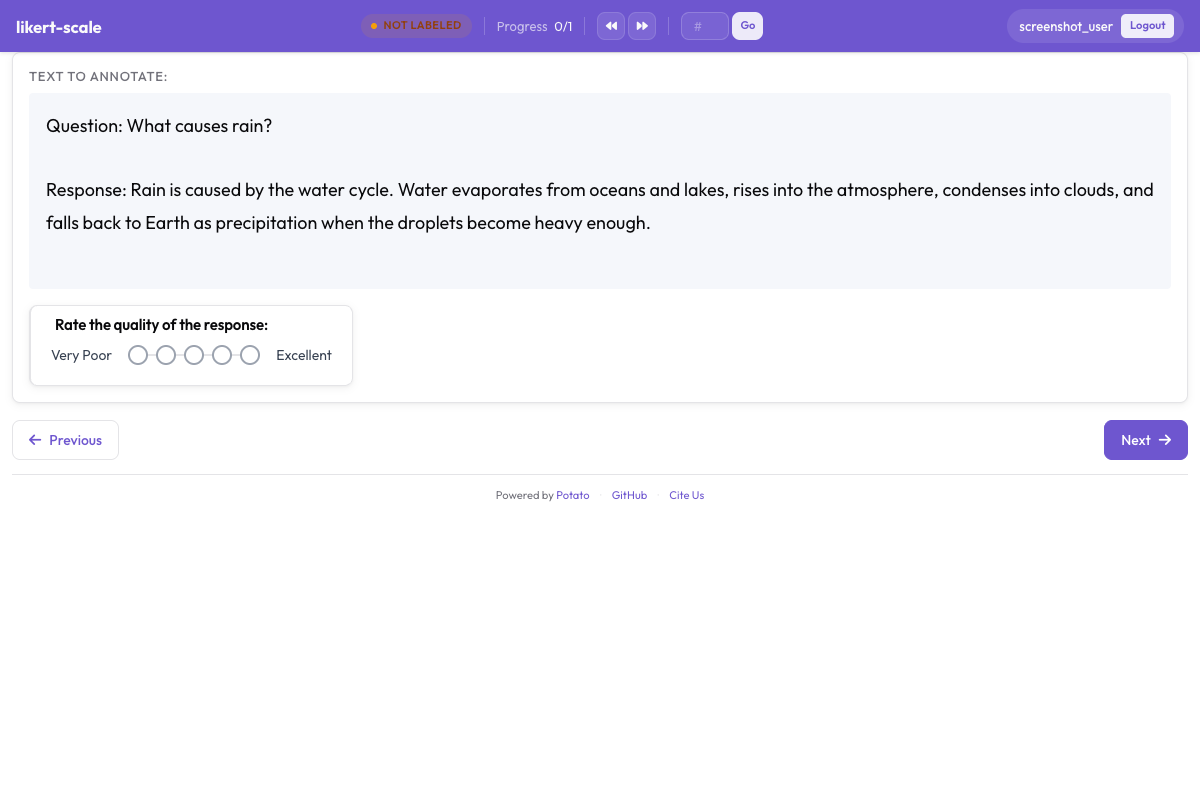 Matrix rating interface for multi-dimensional evaluation in Potato
Basic Configuration
yaml
annotation_schemes:
  - name: "aspect_ratings"
Configuration Options
| Field | Type | Required | Description |
|---|---|---|---|
name | string | Yes | Unique identifier for the annotation |
description | string | Yes | Instructions shown to annotators |
annotation_type | string | Yes | Must be "multirate" |
labels | array | Yes | Items to be rated (rows) |
options | array | Yes | Rating scale options (columns) |
size | number | No | Alternative to options: number of scale points |
min_label | string | No | Label for lowest rating |
max_label | string | No | Label for highest rating |
randomize | boolean | No | Randomize item order |
compact | boolean | No | Use compact layout |
Examples
Response Quality Assessment
yaml
- name: "quality_assessment"Translation Quality
yaml
- name: "translation_quality"Product Review Dimensions
yaml
- name: "product_dimensions"Output Format
A multirate answer is keyed by the option being rated, so each rated item becomes its own entry under the scheme name:
json
{
  "instance_id": "item_1",
  "user_id": "annotator1",
  "labels": {
    "aspect_ratings": {
      "Accuracy": "4",
      "Clarity": "5",
      "Helpfulness": "3"
    }
  },
  "spans": {},
  "links": {}
}
Use Cases
- LLM Evaluation: Rate responses on multiple quality dimensions
- Translation Assessment: Evaluate fluency, adequacy, and terminology
- Product Reviews: Capture ratings across different product aspects
- Survey Research: Likert-style matrix questions
- Peer Review: Rate papers on multiple criteria
Best Practices
- Limit the number of items - 3-7 items works best; more causes fatigue
- Use consistent scales - All items should use the same rating scale
- Order items logically - Group related dimensions together
- Provide clear definitions - Use tooltips to explain each dimension
- Consider randomization - Prevents order bias in responses