Why Potato?
Potato is free and runs on your own hardware. Here is how it compares with ten other annotation and evaluation tools.
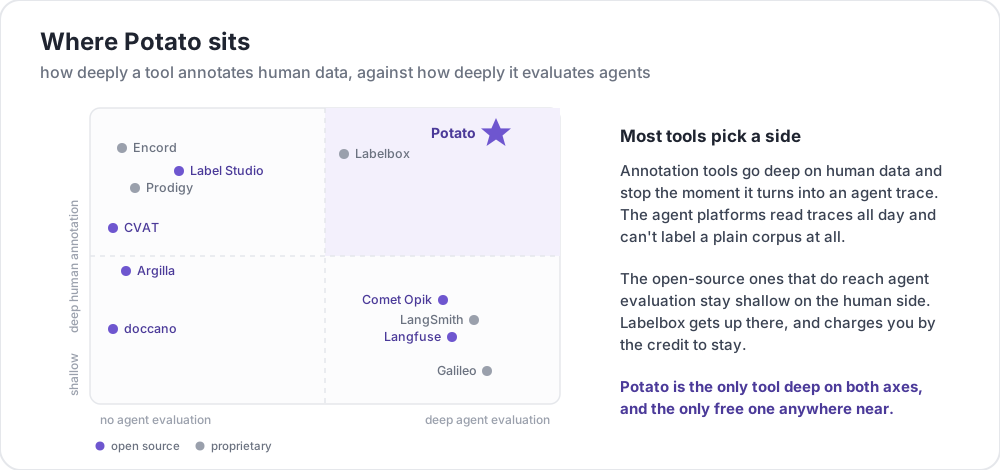 (opens in a new tab)
Potato against ten other tools
We read the documentation for all of them. Most can do some of this work. What differs is how much of it sits behind a paid plan, and how much nobody sells at any price.
| Annotation tools | Vision & enterprise | Agent evaluation | |||||||||
|---|---|---|---|---|---|---|---|---|---|---|---|
| Capability | PotatoGPL-3.0 | Label StudioApache-2.0 | ProdigyProprietary | ArgillaApache-2.0 | CVATMIT | EncordProprietary | LabelboxProprietary | LangSmithProprietary | LangfuseMIT | Comet OpikApache-2.0 | GalileoProprietary |
| What it costs | Free | Free; Starter $99/mo + $49/user; full agreement is Enterprise | $390, or $490/seat (5 min.) | Free | Free; $33/user/mo hosted | Not published | Usage-based credits | $39/seat/mo | Free self-hosted | Free self-hosted | $100/mo |
| Self-hosted, free* | Included, free | Included, free | Paid tier only | Included, free | Included, free | Paid tier only | Paid tier only | Paid tier only | Included, free | Included, free | Paid tier only |
| Every feature, no paid tier* | Included, free | Not offered | Not offered | Included, free | Not offered | Not offered | Not offered | Not offered | Included, free | Included, free | Not offered |
| One tool for corpora and agent traces* | Included, free | Paid tier only | Not offered | Not offered | Not offered | Not offered | Paid tier only | Not offered | Not offered | Not offered | Not offered |
| Agent trace annotation | Included, free | Paid tier only | Not offered | Not offered | Not offered | Not offered | Paid tier only | Included, free | Included, free | Included, free | Included, free |
| Multi-agent graph you can annotate* | Included, free | Not offered | Not offered | Not offered | Not offered | Not offered | Not offered | Partial, see notes | Partial, see notes | Partial, see notes | Partial, see notes |
| Human-labeled failure attribution* | Included, free | Not offered | Not offered | Not offered | Not offered | Not offered | Partial, see notes | Not offered | Not offered | Not offered | Partial, see notes |
| LLM judge measured against human labels | Included, free | Paid tier only | Not offered | Not offered | Not offered | Not offered | Not offered | Included, free | Included, free | Not offered | Included, free |
| Judge calibration error and bias audit | Included, free | Not offered | Not offered | Not offered | Not offered | Not offered | Not offered | Not offered | Not offered | Not offered | Not offered |
| Chance-corrected agreement (κ, α)* | Included, free | Not offered | Paid tier only | Not offered | Not offered | Not offered | Not offered | Not offered | Partial, see notes | Not offered | Not offered |
| Annotator ability modeling (IRT) | Included, free | Not offered | Not offered | Not offered | Not offered | Not offered | Not offered | Not offered | Not offered | Not offered | Not offered |
| Confidence interval on every label | Included, free | Not offered | Not offered | Not offered | Not offered | Not offered | Not offered | Not offered | Not offered | Not offered | Not offered |
| Gold standards and attention checks | Included, free | Paid tier only | Not offered | Not offered | Included, free | Paid tier only | Included, free | Not offered | Not offered | Not offered | Not offered |
| Live norming sessions with an agreement meter | Included, free | Not offered | Not offered | Not offered | Not offered | Not offered | Not offered | Not offered | Not offered | Not offered | Not offered |
| Peer-prediction scoring, no gold labels | Included, free | Not offered | Not offered | Not offered | Not offered | Not offered | Not offered | Not offered | Not offered | Not offered | Not offered |
| SFT, DPO, and process-reward export* | Included, free | Not offered | Not offered | Partial, see notes | Not offered | Paid tier only | Paid tier only | Partial, see notes | Partial, see notes | Not offered | Not offered |
| Chance-corrected agreement over geometry* | Included, free | Not offered | Not offered | Not offered | Not offered | Not offered | Not offered | Not offered | Not offered | Not offered | Not offered |
| Agreement on when an event happens* | Included, free | Not offered | Not offered | Not offered | Not offered | Not offered | Not offered | Not offered | Not offered | Not offered | Not offered |
| Drawing telemetry (accept latency, revisions)* | Included, free | Not offered | Not offered | Not offered | Not offered | Not offered | Not offered | Not offered | Not offered | Not offered | Not offered |
| 3D point clouds and cuboids* | Included, free | Not offered | Not offered | Not offered | Included, free | Paid tier only | Paid tier only | Not offered | Not offered | Not offered | Not offered |
| Runs with no outbound requests* | Included, free | Partial, see notes | Included, free | Partial, see notes | Included, free | Not offered | Paid tier only | Not offered | Partial, see notes | Partial, see notes | Not offered |
| Managed annotation workforce* | Not offered | Not offered | Not offered | Not offered | Paid tier only | Paid tier only | Paid tier only | Not offered | Not offered | Not offered | Not offered |
| Hosted, nothing to run* | Not offered | Paid tier only | Paid tier only | Included, free | Included, free | Paid tier only | Paid tier only | Included, free | Included, free | Included, free | Included, free |
Self-hosted, free: With LangSmith, Galileo, Encord, and Labelbox, self-hosting is itself an enterprise contract. On-premise is an add-on you negotiate with sales rather than an edition you can download.
Every feature, no paid tier: Label Studio's free edition has no agreement metrics of any kind. The hosted Starter plan, at $99 a month plus $49 per additional user, has limited agreement metrics, LLM pre-labeling and benchmarks, and the full versions are Enterprise features, priced on request. CVAT gives away honeypots and ground-truth jobs but keeps its quality reports for paying teams.
One tool for corpora and agent traces: Every agent-evaluation platform here is locked to traces. Ask one of them to label a plain text corpus for sentiment and it has nowhere to put the answer.
Multi-agent graph you can annotate: Four of these tools draw an agent interaction graph, and all four are read-only. In Potato the agents and the handoffs between them are the units a person annotates.
Human-labeled failure attribution: Galileo guesses at handoff failures with an LLM, and Labelbox lets you score trajectory steps. Neither one collects the human ground truth you would check that guess against.
Chance-corrected agreement (κ, α): The others report agreement as percent overlap, IoU, or a majority vote. Prodigy is the exception and ships Krippendorff's α and Gwet's AC2, but it has no free tier at all. Langfuse's Cohen's κ compares one human against one judge, not a pool of annotators against each other.
SFT, DPO, and process-reward export: Partial means SFT-style JSONL only, with no preference-pair or process-reward format.
Chance-corrected agreement over geometry: We have found no other annotation platform that reports chance-corrected agreement over spatial labels. CVAT's consensus engine and V7's consensus stage both compare annotators with raw IoU against a per-class threshold, and Label Studio Enterprise's metric list is exact match, numeric difference, IoU and span overlap. None of them corrects for chance, which matters because mean IoU can read about 0.95 on a corpus of large centered objects even for an annotator who never looks at the image.
Agreement on when an event happens: Temporal IoU and boundary agreement, with the matching tolerance reported as a sweep rather than at one threshold. Agreement at 0.25 s and at 2 s are different claims about the same data.
Drawing telemetry (accept latency, revisions): Time per shape, stroke dynamics, revision counts and AI-suggestion accept latency. This matters because agreement goes up when annotators rubber-stamp pre-labels, so timing records separate review from acceptance. No coordinates are recorded.
3D point clouds and cuboids: CVAT also does this, and the 3D specialists (Segments.ai, Kognic, Supervisely) go deeper, with point-cloud sequences and track propagation Potato does not have. Potato's addition is exact rotated 3D IoU between annotators.
Runs with no outbound requests: Every stylesheet, script, font and icon serves from the install across all 14 templates, verified live at 62 requests and zero external. Models are a one-time transfer. Partial means self-hostable, but the rendered page still fetches third-party assets.
Managed annotation workforce: We don't have one. You bring your own annotators or recruit through Prolific. If you need 50,000 items labeled by next month and nobody to label them, Labelbox, Encord, and Scale sell exactly that, and we don't.
Hosted, nothing to run: Potato is self-hosted only. For a lab with a spare server that's the whole appeal. If you don't want to run anything at all, it's a real cost and you should weigh it.
Checked against public documentation in August 2026. These products change quickly, so if we have a cell wrong we'd like to know. Tell us what we got wrong.
Seven reasons teams switch
Free, with no tiers
There is no paid plan, because there is no plan. Every feature on this page behaves the same whether you're one graduate student or a company of four hundred. Nothing is metered and nobody asks for a card.
Annotator reliability and item difficulty
Most tools store what an annotator clicked. Potato also estimates how reliable each annotator is and how hard each item was, so a label comes back with a confidence interval instead of a majority vote pretending to be a fact.
Open source
GPL-3.0, all of it on GitHub. You can read how the statistics are computed, change the parts you disagree with, and keep running your fork long after we lose interest. Several tools on this page are open source too. Fewer of them give you the whole product.
Your data stays put
Potato runs on your laptop or your server and never phones home. That is what makes it usable for medical notes and unpublished corpora that legal won't let near someone else's cloud.
Built in a research lab
Potato came out of the University of Michigan, with papers at ACL 2026 and EMNLP 2022 and a Best Demo Award at HCOMP 2024. If a reviewer asks how your agreement numbers were computed, the method is published and you can cite it.
It's a YAML file
A working annotation task is about twenty lines of config. There is no plugin API to learn and no build step. Whoever writes your codebook can set up the study without waiting on an engineer.
Agent evaluation
Potato converts 15 agent trace formats and draws a multi-agent run as an interaction graph whose agents and handoffs an annotator labels. It adds schemas for computer-use, voice and video agents, coding-agent diffs, process-reward annotation, and live observation with rollback. The other platforms in this table render an agent graph read-only.
Who uses Potato
Academic researchers
Free, citable, and self-hosted, which is usually what an IRB and a grant budget both need.
Industry teams
Runs on your own infrastructure. No per-seat license, and no vendor sitting on your labels.
Startups and small teams
Start this afternoon with a pip install instead of a procurement cycle.
Privacy-sensitive projects
Works fully offline, which is why it ends up on medical notes and student records that can't go to a vendor's cloud.
Educators and students
Free for a whole class. No seats to buy, no licenses to chase at the start of term.
Individual developers
Build a training set for your own model without signing up for anything.
Try it
One pip install and you're annotating. There is nothing to sign up for.