セマンティックディファレンシャル
Potatoでセマンティックディファレンシャル尺度を設定し、対になる形容詞と任意の段階数を使って態度や印象を測定する方法を解説します。
セマンティックディファレンシャルのアノテーションスキーマは、態度・知覚・言葉の含意を測るために、両端に反対の意味を持つ形容詞を配置した尺度をアノテーターに提示します。各尺度は両端が対になる形容詞(たとえば「Good」と「Bad」)で構成され、アノテーターはその間のどこに当てはまるかを選びます。
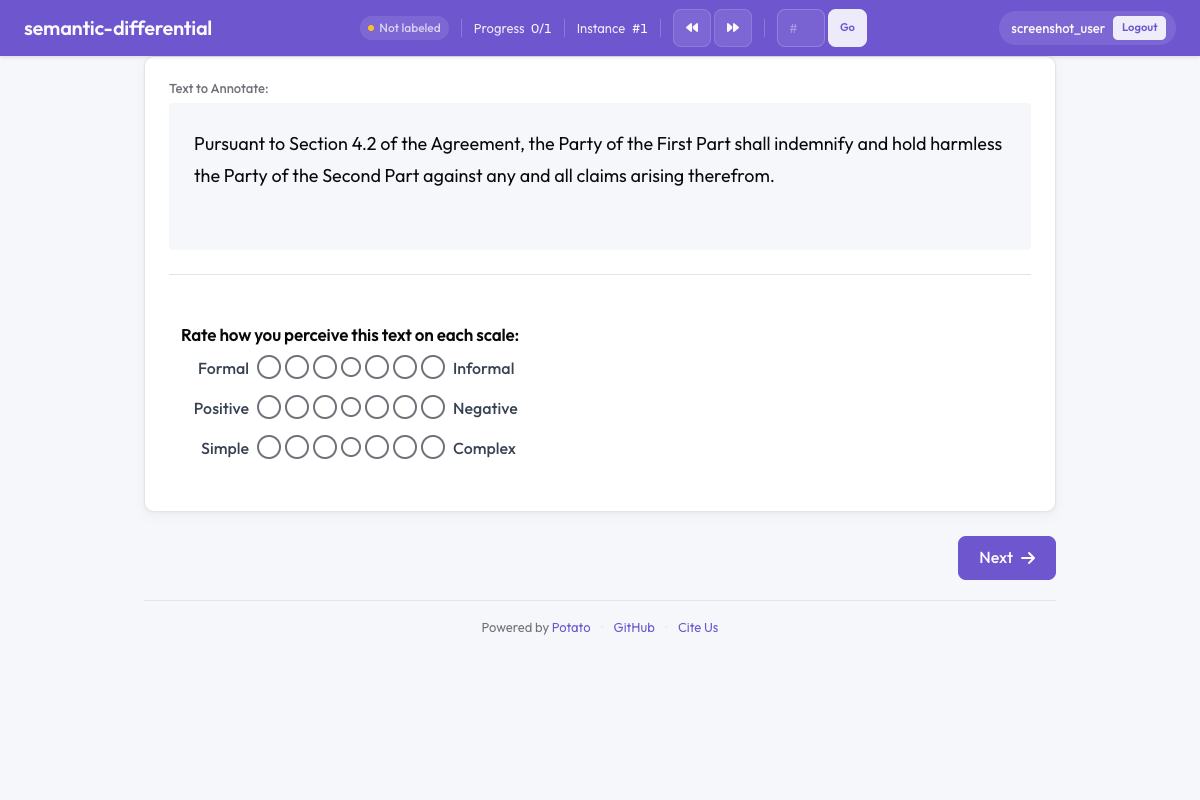 Semantic differential in Potato
概要
セマンティックディファレンシャル尺度は1950年代にCharles Osgoodが開発したもので、概念の含意的な意味を測る手法として心理学や社会科学で長く使われてきました。アノテーションタスクでは、単一の評価尺度では表せない多次元的で微妙な受け取られ方を記録するのに役立ちます。
クイックスタート
yaml
annotation_schemes:
  - annotation_type: semantic_differential
    name: text_perception
    description: Rate how you perceive this text on each scale.
    pairs:
      - ["Formal", "Informal"]
      - ["Positive", "Negative"]
      - ["Simple", "Complex"]
    scale_points: 7
設定オプション
| フィールド | 型 | デフォルト | 説明 |
|---|---|---|---|
annotation_type | string | 必須 | "semantic_differential"を指定します |
name | string | 必須 | このスキーマの一意な識別子 |
description | string | 必須 | アノテーターに表示される指示文 |
pairs | array | 必須 | [左の形容詞, 右の形容詞]のペアのリスト |
scale_points | integer | 7 | 各尺度の段階数(通常は5または7) |
show_center_label | boolean | true | 尺度の中央に「Neutral」のラベルを表示するか |
label_requirement.required | boolean | false | 次に進む前にすべての尺度への回答を必須にするか |
例
文章スタイルの評価
yaml
annotation_schemes:
  - annotation_type: semantic_differential
    name: writing_style
    description: Rate the writing style of this text on each dimension.
    pairs:
      - ["Formal", "Informal"]
      - ["Objective", "Subjective"]
      - ["Concise", "Verbose"]
      - ["Clear", "Ambiguous"]
    scale_points: 7
話し手の印象
yaml
annotation_schemes:
  - annotation_type: semantic_differential
    name: speaker_impression
    description: Rate your impression of the speaker on each dimension.
    pairs:
      - ["Competent", "Incompetent"]
      - ["Warm", "Cold"]
      - ["Trustworthy", "Untrustworthy"]
      - ["Dominant", "Submissive"]
    scale_points: 7
商品の評価
yaml
annotation_schemes:
  - annotation_type: semantic_differential
    name: product_perception
    description: How do you perceive this product?
    pairs:
      - ["Innovative", "Traditional"]
      - ["Affordable", "Expensive"]
      - ["Reliable", "Unreliable"]
      - ["Simple", "Complex"]
    scale_points: 5
感情の次元(EPA)
古典的なEvaluation-Potency-Activityの枠組みです。
yaml
annotation_schemes:
  - annotation_type: semantic_differential
    name: epa_rating
    description: Rate this concept on each dimension.
    pairs:
      - ["Good", "Bad"]
      - ["Powerful", "Weak"]
      - ["Active", "Passive"]
    scale_points: 7
出力形式
json
{
  "text_perception": {
    "labels": {
      "Formal-Informal": 5,
      "Positive-Negative": 2,
      "Simple-Complex": 4
    }
  }
}値は1(左の形容詞)からscale_points(右の形容詞)までの範囲になり、中間点が中立を表します。
ベストプラクティス
- 既定では7段階の尺度を使う - セマンティックディファレンシャル研究の標準であり、十分な細かさが得られます
- ペアごとに極性のバランスを取る - 「肯定的」な形容詞が来る側を左右で混ぜると、回答パターンの固定化を防げます
- 1アイテムあたり5〜8ペアに抑える - 尺度が多すぎると疲労を招き、データの質が下がります
- 既存の形容詞ペアを使う - 先行研究で検証済みのペアがあれば、それを流用してください
- 中央のラベルは残す - 中立の中間点は、アノテーターにとって重要な基準になります
- ペアの順序をランダム化する - 可能であれば提示順を変えて、アンカリング効果を抑えてください
参考資料
- Likertスケール - 同意度や頻度を測る順序尺度
- スライダー - 連続値のアノテーション
- ペアワイズ比較 - 2つのアイテムを直接比較
実装の詳細については、ソースドキュメントを参照してください。