ルーブリック評価
Potatoで複数観点の評価グリッドを構築します。LLM出力の評価、小論文の採点、翻訳品質の判定など、ルーブリックに沿った構造的なアノテーションに使えます。
ルーブリック評価のアノテーションスキーマは、決められた尺度で複数の観点からコンテンツを採点するための、構造化されたグリッドインターフェースを提供します。LLM出力の評価、小論文の採点、翻訳品質の判定など、多次元の採点が必要なタスクに使えます。
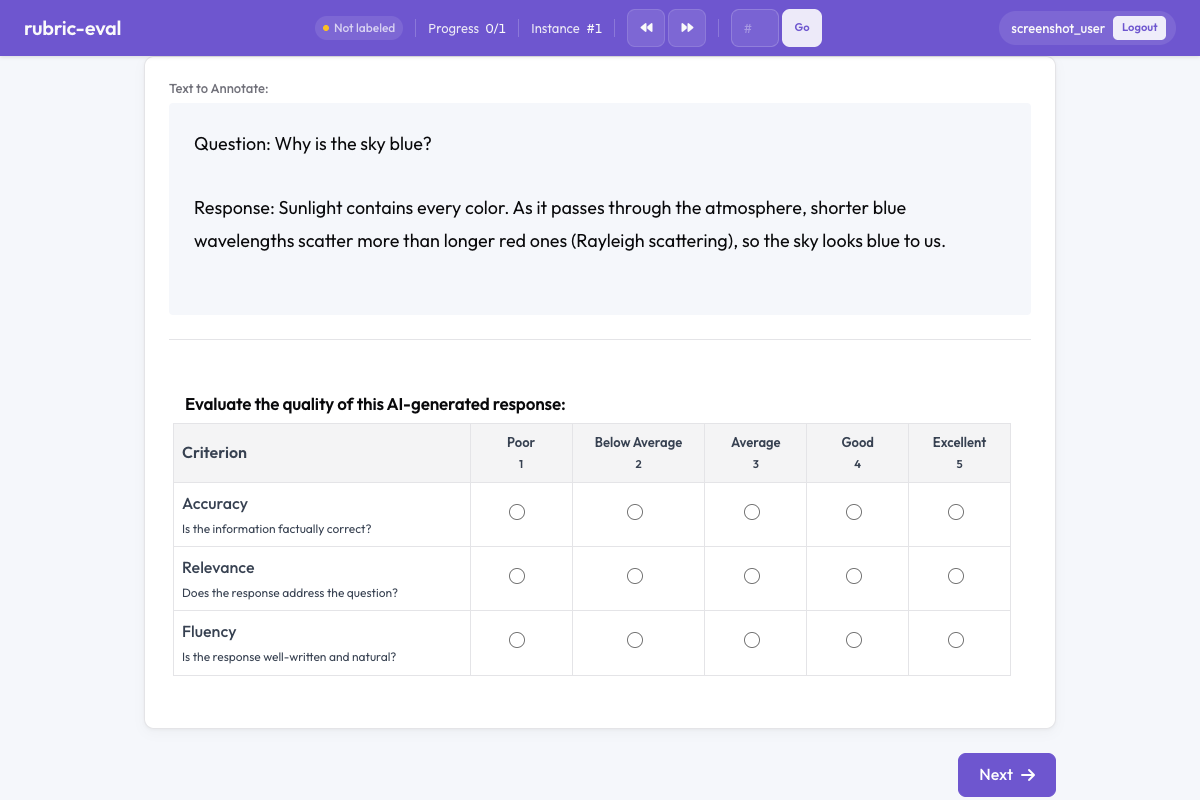 Rubric evaluation in Potato
概要
ルーブリック評価スキーマが表示するもの:
- 観点のグリッド(それぞれに独自の評価尺度が付きます)
- 尺度のラベル(Poor から Excellent まで。変更可能です)
- 総合スコア(任意。観点全体をまとめた値です)
- 各観点の説明文(アノテーターの判断の手がかりになります)
生成AIの出力を人手で構造的に評価する場面でとくに役立ちます。
クイックスタート
yaml
annotation_schemes:
  - annotation_type: rubric_eval
    name: response_quality
    description: Evaluate the quality of this AI-generated response.
    scale_points: 5
    criteria:
      - name: Accuracy
        description: Is the information factually correct?
      - name: Relevance
        description: Does the response address the question?
      - name: Fluency
        description: Is the response well-written and natural?
設定オプション
| フィールド | 型 | デフォルト | 説明 |
|---|---|---|---|
annotation_type | string | 必須 | "rubric_eval"を指定します |
name | string | 必須 | このスキーマの一意な識別子 |
description | string | 必須 | アノテーターに表示される指示文 |
scale_points | integer | 5 | 評価尺度の段階数 |
scale_labels | array | ["Poor", "Fair", "Average", "Good", "Excellent"] | 各段階のラベル(要素数はscale_pointsと一致させます) |
criteria | array | 必須 | 観点オブジェクトのリスト。それぞれnameと、任意でdescriptionを持ちます |
show_overall | boolean | false | 観点の下に総合スコアの行を追加で表示するか |
例
LLM出力の評価
yaml
annotation_schemes:
  - annotation_type: rubric_eval
    name: llm_eval
    description: Rate the quality of this model-generated response.
    scale_points: 5
    scale_labels:
      - Poor
      - Fair
      - Average
      - Good
      - Excellent
    show_overall: true
    criteria:
      - name: Helpfulness
        description: Does the response provide useful and actionable information?
      - name: Accuracy
        description: Is the response factually correct and free of hallucinations?
      - name: Harmlessness
        description: Is the response free of harmful, biased, or inappropriate content?
      - name: Coherence
        description: Is the response logically structured and easy to follow?
小論文の採点
yaml
annotation_schemes:
  - annotation_type: rubric_eval
    name: essay_grade
    description: Grade this student essay using the rubric below.
    scale_points: 4
    scale_labels:
      - Below Expectations
      - Approaching
      - Meets Expectations
      - Exceeds Expectations
    criteria:
      - name: Thesis
        description: Is there a clear and arguable thesis statement?
      - name: Evidence
        description: Does the essay use relevant evidence to support claims?
      - name: Organization
        description: Is the essay logically organized with clear transitions?
      - name: Grammar
        description: Is the writing free of grammatical and spelling errors?
翻訳品質の評価
yaml
annotation_schemes:
  - annotation_type: rubric_eval
    name: translation_quality
    description: Evaluate the quality of this machine translation.
    scale_points: 3
    scale_labels:
      - Unacceptable
      - Acceptable
      - Perfect
    criteria:
      - name: Adequacy
        description: Does the translation convey the same meaning as the source?
      - name: Fluency
        description: Does the translation read naturally in the target language?
      - name: Terminology
        description: Are domain-specific terms translated correctly?
出力形式
json
{
  "response_quality": {
    "labels": {
      "Accuracy": 4,
      "Relevance": 5,
      "Fluency": 3
    },
    "overall": 4
  }
}各観点は、選択された尺度の値(1始まり)に対応します。overallフィールドが含まれるのはshow_overallがtrueのときだけです。
ベストプラクティス
- 観点を独立させる - 各観点が別々の次元を測るようにして、採点の重複を避けてください
- 説明文を明確に書く - それぞれの観点が何を測るのか、曖昧さなく伝わるようにしてください
- 段階数は3〜5に - 段階が少ないほど負担が軽くなります。7を超えても信頼性はほとんど上がりません
- 基準となる例を示す - 尺度の両端がどのようなものかを説明文に書いておいてください
- 集計するなら総合スコアを有効に - 詳細な内訳と併せて1つの要約指標が必要な場合、
show_overallが役立ちます
参考資料
- Likertスケール - 単一次元の評価尺度
- ペアワイズ比較 - 2件を並べて比較する評価
- 品質管理 - 注意チェックとゴールドスタンダード
実装の詳細については、ソースドキュメントを参照してください。