置信度標註
在 Potato 中給其他標註配上置信度評分,用李克特量表或滑塊記錄標註者對自己判斷的確信程度。
置信度標註方案讓標註者對自己剛做出的另一項標註給出確信程度。它把一個置信度量表(李克特或滑塊)和目標標註方案關聯起來,這樣研究者不僅能拿到標註者選了什麼,還能知道他們有多確定。
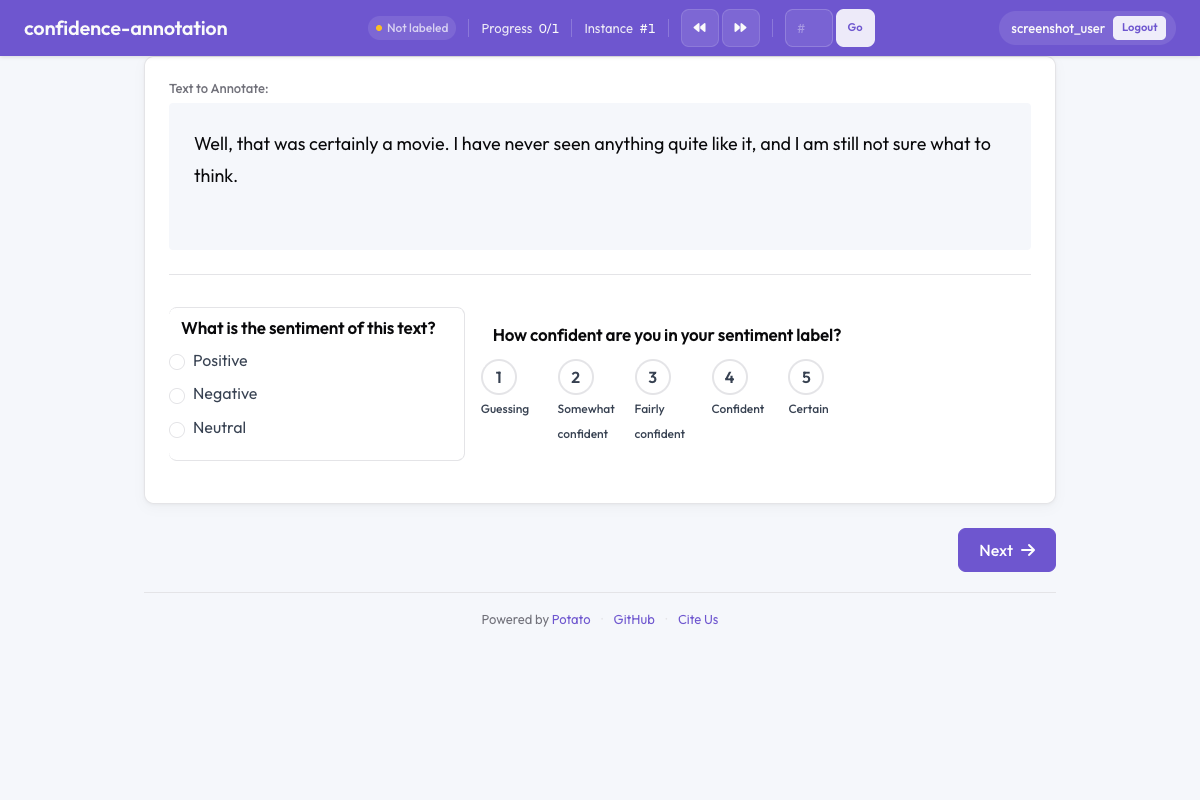 Confidence annotation in Potato
概覽
置信度標註對研究標註品質、找出有歧義的條目、在聚合時給標籤加權都很關鍵。配置之後,目標標註旁邊會出現一個置信度控制元件,提示標註者說明自己對這個判斷有多確定。
快速開始
yaml
annotation_schemes:
  - annotation_type: radio
    name: sentiment
    description: What is the sentiment of this text?
    labels: ["Positive", "Negative", "Neutral"]

  - annotation_type: confidence
    name: sentiment_confidence
    description: How confident are you in your sentiment label?
    target_schema: sentiment
    scale_type: likert
    scale_points: 5
配置項
| 欄位 | 類型 | 預設值 | 說明 |
|---|---|---|---|
annotation_type | string | 必填 | 必須為 "confidence" |
name | string | 必填 | 本方案的唯一識別符號 |
description | string | 必填 | 展示給標註者的說明文字 |
target_schema | string | 可選 | 這項置信度對應的標註方案名稱 |
scale_type | string | "likert" | 量表類型:"likert" 為離散檔位,"slider" 為連續取值 |
scale_points | integer | 5 | 李克特量表的檔位數(滑塊模式下忽略) |
labels | array | 可選 | 各檔位的自定義標籤(例如 ["Not confident", "Very confident"]) |
slider_min | integer | — | 滑塊最小值(僅當 scale_type 為 "slider" 時使用) |
slider_max | integer | — | 滑塊最大值(僅當 scale_type 為 "slider" 時使用) |
label_requirement.required | boolean | false | 是否必須填寫置信度才能繼續 |
示例
李克特置信度量表
yaml
annotation_schemes:
  - annotation_type: radio
    name: toxicity
    description: Is this comment toxic?
    labels: ["Toxic", "Not Toxic"]

  - annotation_type: confidence
    name: toxicity_confidence
    description: How confident are you in your toxicity judgment?
    target_schema: toxicity
    scale_type: likert
    scale_points: 5
    labels: ["Not at all confident", "Slightly confident", "Moderately confident", "Very confident", "Extremely confident"]
滑塊置信度量表
yaml
annotation_schemes:
  - annotation_type: radio
    name: stance
    description: What stance does the author take?
    labels: ["Support", "Oppose", "Neutral"]

  - annotation_type: confidence
    name: stance_confidence
    description: Rate your confidence from 0 (guessing) to 100 (certain).
    target_schema: stance
    scale_type: slider
必填的置信度評分
yaml
annotation_schemes:
  - annotation_type: multiselect
    name: topics
    description: Select all topics that apply.
    labels: ["Politics", "Economy", "Health", "Education"]

  - annotation_type: confidence
    name: topics_confidence
    description: How confident are you in your topic selections?
    target_schema: topics
    scale_type: likert
    scale_points: 3
    labels: ["Low", "Medium", "High"]
獨立使用的置信度(不關聯目標)
置信度標註也可以不指定目標方案,單獨用於一般性的自我評估:
yaml
annotation_schemes:
  - annotation_type: confidence
    name: task_familiarity
    description: How familiar are you with this topic area?
    scale_type: likert
    scale_points: 5
    labels: ["Not familiar", "Slightly familiar", "Somewhat familiar", "Very familiar", "Expert"]
輸出格式
json
{
  "toxicity_confidence": {
    "labels": {
      "confidence": 4
    }
  }
}
李克特量表的取值範圍是 1 到 scale_points;滑塊的取值範圍是 slider_min 到 slider_max。
實踐建議
- 儘量關聯目標方案 —— 置信度和具體的標註決策掛鉤時才最有價值
- 求簡單就用李克特 —— 離散量表對標註者來說更快也更好上手
- 求精細就用滑塊 —— 後續分析需要精確的置信度數值時用它
- 把置信度設為必填 —— 選填的置信度經常被跳過,資料可用性會下降
- 分析置信度分佈 —— 低置信度的條目適合拿去仲裁或追加標註
延伸閱讀
有關實現詳情,請參閱源文件。