语义差异量表
在 Potato 中配置语义差异量表,用两极形容词对测量态度,档位数可自行设定。
语义差异量表标注方案给标注者呈现一组两极形容词量表,用于测量态度、感受或概念的内涵意义。每条量表的两端是一对相反的形容词(例如 Good 与 Bad),标注者在这条谱系上选一个位置来表示条目落在哪里。
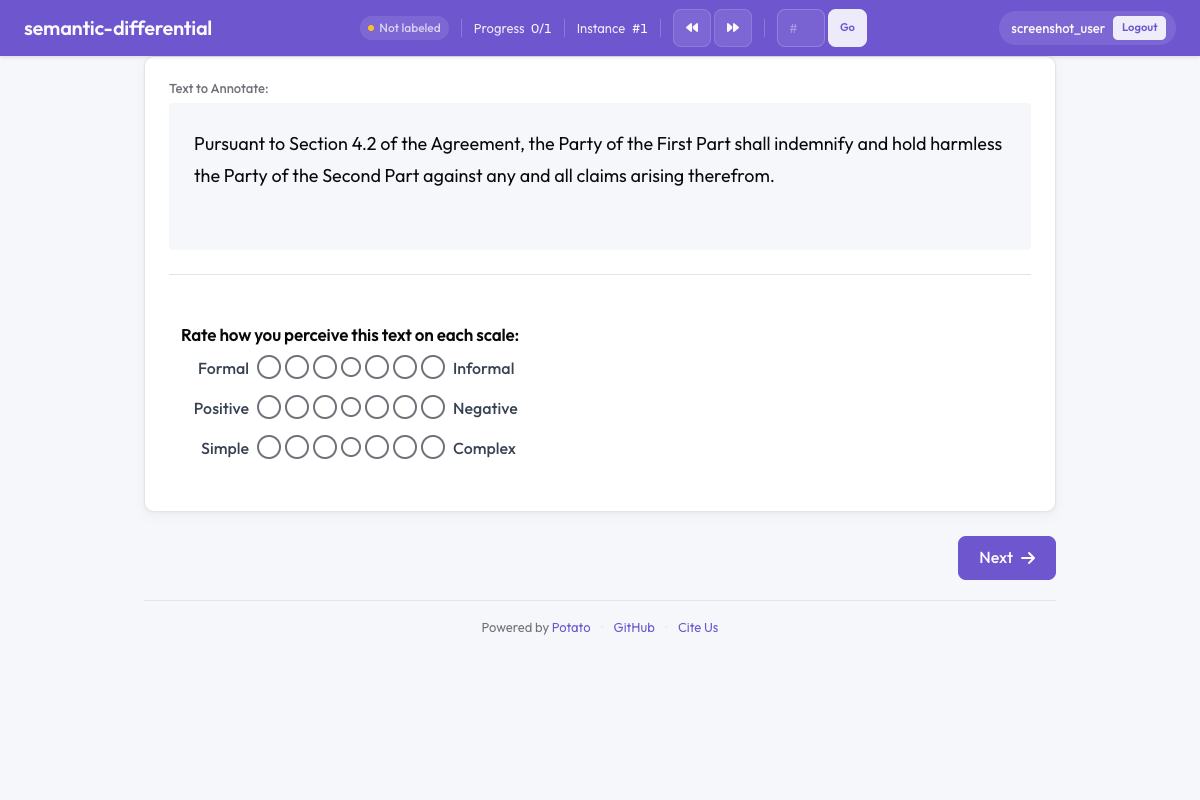 Semantic differential in Potato
概览
语义差异量表由 Charles Osgood 在 1950 年代提出,是心理学和社会科学中测量概念内涵意义的成熟方法。在标注任务里,它适合捕捉单一评分量表表达不了的、细致的多维度感受。
快速开始
yaml
annotation_schemes:
  - annotation_type: semantic_differential
    name: text_perception
    description: Rate how you perceive this text on each scale.
    pairs:
      - ["Formal", "Informal"]
      - ["Positive", "Negative"]
      - ["Simple", "Complex"]
    scale_points: 7
配置项
| 字段 | 类型 | 默认值 | 说明 |
|---|---|---|---|
annotation_type | string | 必填 | 必须为 "semantic_differential" |
name | string | 必填 | 本方案的唯一标识符 |
description | string | 必填 | 展示给标注者的说明文字 |
pairs | array | 必填 | [左侧形容词, 右侧形容词] 组成的列表 |
scale_points | integer | 7 | 每条两极量表的档位数(通常为 5 或 7) |
show_center_label | boolean | true | 是否在量表中点显示 Neutral 标签 |
label_requirement.required | boolean | false | 是否所有量表都必须评分才能继续 |
示例
文本风格评估
yaml
annotation_schemes:
  - annotation_type: semantic_differential
    name: writing_style
    description: Rate the writing style of this text on each dimension.
    pairs:
      - ["Formal", "Informal"]
      - ["Objective", "Subjective"]
      - ["Concise", "Verbose"]
      - ["Clear", "Ambiguous"]
    scale_points: 7
说话人印象
yaml
annotation_schemes:
  - annotation_type: semantic_differential
    name: speaker_impression
    description: Rate your impression of the speaker on each dimension.
    pairs:
      - ["Competent", "Incompetent"]
      - ["Warm", "Cold"]
      - ["Trustworthy", "Untrustworthy"]
      - ["Dominant", "Submissive"]
    scale_points: 7
产品评价
yaml
annotation_schemes:
  - annotation_type: semantic_differential
    name: product_perception
    description: How do you perceive this product?
    pairs:
      - ["Innovative", "Traditional"]
      - ["Affordable", "Expensive"]
      - ["Reliable", "Unreliable"]
      - ["Simple", "Complex"]
    scale_points: 5
情感维度(EPA)
经典的评价-效力-活动(Evaluation-Potency-Activity)框架:
yaml
annotation_schemes:
  - annotation_type: semantic_differential
    name: epa_rating
    description: Rate this concept on each dimension.
    pairs:
      - ["Good", "Bad"]
      - ["Powerful", "Weak"]
      - ["Active", "Passive"]
    scale_points: 7
输出格式
json
{
  "text_perception": {
    "labels": {
      "Formal-Informal": 5,
      "Positive-Negative": 2,
      "Simple-Complex": 4
    }
  }
}
取值从 1(左侧形容词)到 scale_points(右侧形容词),中点表示中立。
实践建议
- 默认用 7 档量表 —— 这是语义差异研究的通行做法,粒度也够用
- 让极性方向交错 —— 把「正面」形容词分散在左右两侧,避免标注者形成固定的作答模式
- 每个条目控制在 5 到 8 对 —— 量表太多会让人疲劳,数据质量随之下降
- 优先用现成的形容词对 —— 已有研究中验证过的形容词对可以直接复用
- 保留中点标签 —— 中立点是标注者重要的参照
- 打乱形容词对的顺序 —— 条件允许的话变换呈现顺序,减少锚定效应
延伸阅读
有关实现详情,请参阅源文档。