置信度标注
在 Potato 中给其他标注配上置信度评分,用李克特量表或滑块记录标注者对自己判断的确信程度。
置信度标注方案让标注者对自己刚做出的另一项标注给出确信程度。它把一个置信度量表(李克特或滑块)和目标标注方案关联起来,这样研究者不仅能拿到标注者选了什么,还能知道他们有多确定。
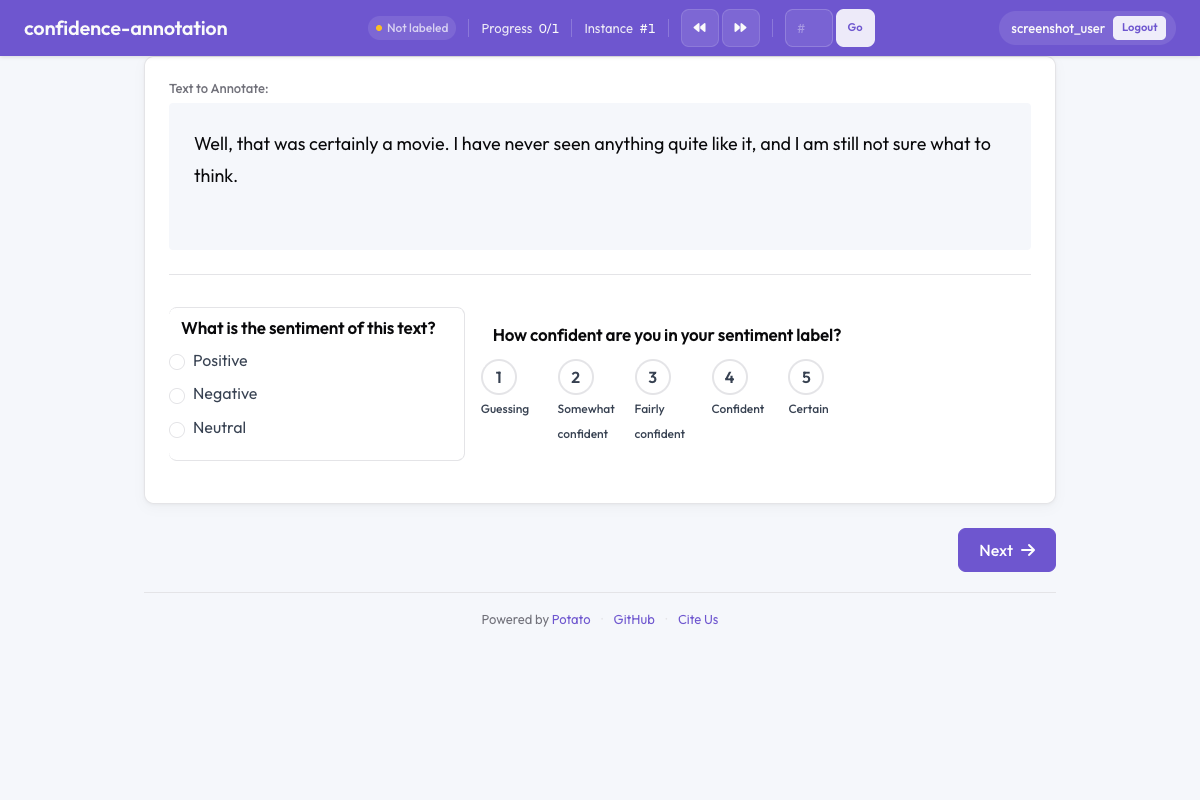 Confidence annotation in Potato
概览
置信度标注对研究标注质量、找出有歧义的条目、在聚合时给标签加权都很关键。配置之后,目标标注旁边会出现一个置信度控件,提示标注者说明自己对这个判断有多确定。
快速开始
yaml
annotation_schemes:
  - annotation_type: radio
    name: sentiment
    description: What is the sentiment of this text?
    labels: ["Positive", "Negative", "Neutral"]

  - annotation_type: confidence
    name: sentiment_confidence
    description: How confident are you in your sentiment label?
    target_schema: sentiment
    scale_type: likert
    scale_points: 5
配置项
| 字段 | 类型 | 默认值 | 说明 |
|---|---|---|---|
annotation_type | string | 必填 | 必须为 "confidence" |
name | string | 必填 | 本方案的唯一标识符 |
description | string | 必填 | 展示给标注者的说明文字 |
target_schema | string | 可选 | 这项置信度对应的标注方案名称 |
scale_type | string | "likert" | 量表类型:"likert" 为离散档位,"slider" 为连续取值 |
scale_points | integer | 5 | 李克特量表的档位数(滑块模式下忽略) |
labels | array | 可选 | 各档位的自定义标签(例如 ["Not confident", "Very confident"]) |
slider_min | integer | — | 滑块最小值(仅当 scale_type 为 "slider" 时使用) |
slider_max | integer | — | 滑块最大值(仅当 scale_type 为 "slider" 时使用) |
label_requirement.required | boolean | false | 是否必须填写置信度才能继续 |
示例
李克特置信度量表
yaml
annotation_schemes:
  - annotation_type: radio
    name: toxicity
    description: Is this comment toxic?
    labels: ["Toxic", "Not Toxic"]

  - annotation_type: confidence
    name: toxicity_confidence
    description: How confident are you in your toxicity judgment?
    target_schema: toxicity
    scale_type: likert
    scale_points: 5
    labels: ["Not at all confident", "Slightly confident", "Moderately confident", "Very confident", "Extremely confident"]
滑块置信度量表
yaml
annotation_schemes:
  - annotation_type: radio
    name: stance
    description: What stance does the author take?
    labels: ["Support", "Oppose", "Neutral"]

  - annotation_type: confidence
    name: stance_confidence
    description: Rate your confidence from 0 (guessing) to 100 (certain).
    target_schema: stance
    scale_type: slider
    min_value: 0
    max_value: 100
    step: 1
    left_label: "Guessing"
    right_label: "Certain"
必填的置信度评分
yaml
annotation_schemes:
  - annotation_type: multiselect
    name: topics
    description: Select all topics that apply.
    labels: ["Politics", "Economy", "Health", "Education"]

  - annotation_type: confidence
    name: topics_confidence
    description: How confident are you in your topic selections?
    target_schema: topics
    scale_type: likert
    scale_points: 3
    labels: ["Low", "Medium", "High"]
独立使用的置信度(不关联目标)
置信度标注也可以不指定目标方案,单独用于一般性的自我评估:
yaml
annotation_schemes:
  - annotation_type: confidence
    name: task_familiarity
    description: How familiar are you with this topic area?
    scale_type: likert
    scale_points: 5
    labels: ["Not familiar", "Slightly familiar", "Somewhat familiar", "Very familiar", "Expert"]
输出格式
json
{
  "toxicity_confidence": {
    "labels": {
      "confidence": 4
    }
  }
}
李克特量表的取值范围是 1 到 scale_points;滑块的取值范围是 slider_min 到 slider_max。
实践建议
- 尽量关联目标方案 —— 置信度和具体的标注决策挂钩时才最有价值
- 求简单就用李克特 —— 离散量表对标注者来说更快也更好上手
- 求精细就用滑块 —— 后续分析需要精确的置信度数值时用它
- 把置信度设为必填 —— 选填的置信度经常被跳过,数据可用性会下降
- 分析置信度分布 —— 低置信度的条目适合拿去仲裁或追加标注
延伸阅读
有关实现详情,请参阅源文档。