卡片分类
在 Potato 中搭建拖放式卡片分类界面,用于分组、归类和信息架构任务,支持封闭式与开放式两种分类模式。
卡片分类标注方案提供一个拖放界面,把条目归入不同的分组。它适合信息架构研究、内容归类,以及任何需要标注者把条目组织成有意义分组的任务。
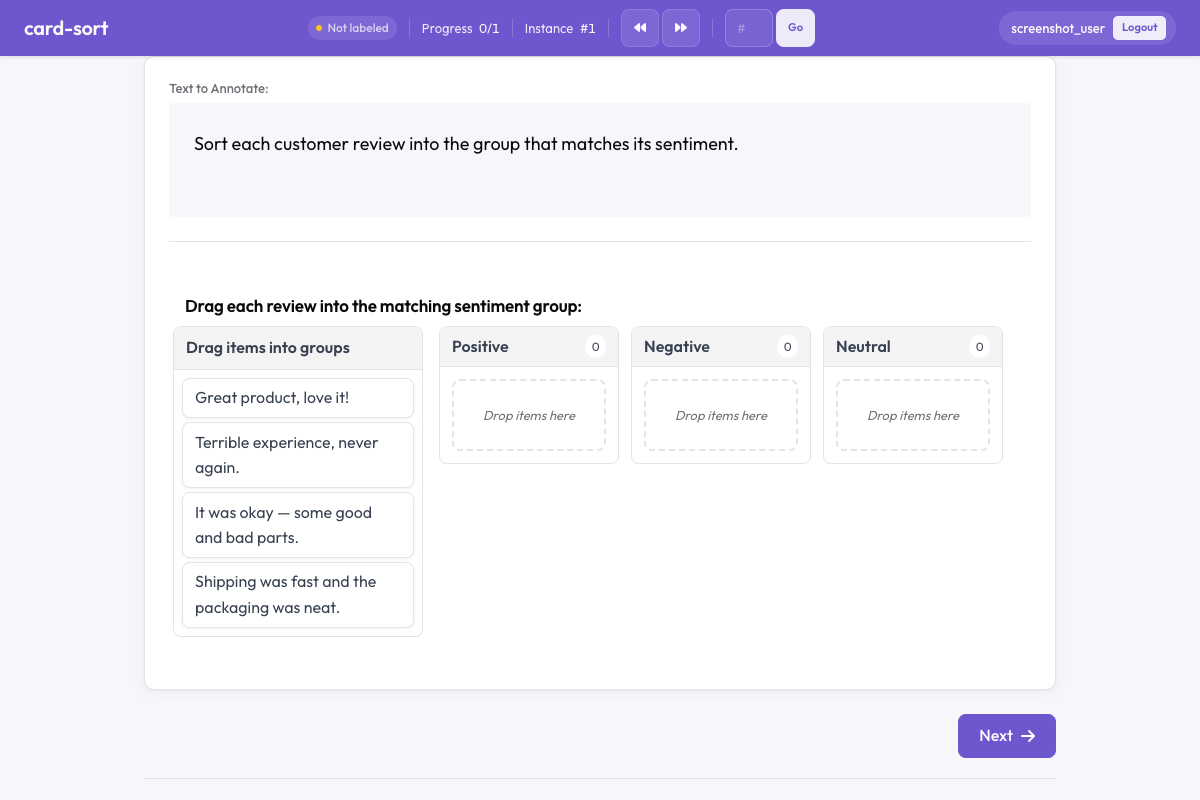 Card sort in Potato
概览
卡片分类方案支持两种模式:
- 封闭式分类 —— 标注者把卡片拖入预先定义好的分组
- 开放式分类 —— 标注者自己创建分组并命名
卡片是可拖动的元素,标注者把它们放进分组容器来完成整理。
快速开始
yaml
annotation_schemes:
  - annotation_type: card_sort
    name: content_grouping
    description: Drag each card into the most appropriate group.
    mode: closed
    groups:
      - Positive
      - Negative
      - Neutral
配置项
| 字段 | 类型 | 默认值 | 说明 |
|---|---|---|---|
annotation_type | string | 必填 | 必须为 "card_sort" |
name | string | 必填 | 本方案的唯一标识符 |
description | string | 必填 | 展示给标注者的说明文字 |
mode | string | 必填 | "closed"(预定义分组)或 "open"(标注者自建分组) |
groups | array | 封闭式必填 | 封闭式分类的分组名称列表 |
items_field | string | "items" | 数据 JSON 中存放卡片条目列表的字段 |
allow_empty_groups | boolean | true | 提交时是否允许分组为空 |
allow_multiple | boolean | false | 同一张卡片是否可以放进多个分组 |
示例
情感分类(封闭式)
yaml
annotation_schemes:
  - annotation_type: card_sort
    name: sentiment_sort
    description: Sort each comment into the appropriate sentiment category.
    mode: closed
    groups:
      - Positive
      - Negative
      - Mixed
      - Off-topic
    allow_empty_groups: true
配套的示例数据:
json
{
  "id": "batch_001",
  "items": [
    "Great product, love it!",
    "Terrible experience, never again.",
    "It was okay, some good and bad parts.",
    "Anyone know the weather today?"
  ]
}
用于信息架构的开放式卡片分类
yaml
annotation_schemes:
  - annotation_type: card_sort
    name: ia_sort
    description: >
      Group these menu items into categories that make sense to you.
      Name each group with a descriptive label.
    mode: open
    items_field: "menu_items"
    allow_empty_groups: false
多标签分组
yaml
annotation_schemes:
  - annotation_type: card_sort
    name: theme_sort
    description: >
      Sort each statement into relevant themes.
      A statement can belong to multiple themes.
    mode: closed
    groups:
      - Economy
      - Healthcare
      - Education
      - Environment
      - Security
    allow_multiple: true
输出格式
json
{
  "content_grouping": {
    "groups": {
      "Positive": ["Great product, love it!"],
      "Negative": ["Terrible experience, never again."],
      "Mixed": ["It was okay, some good and bad parts."],
      "Off-topic": ["Anyone know the weather today?"]
    }
  }
}
开放式分类下,分组名称是标注者自己写的字符串。
实践建议
- 要结果一致就用封闭式分类 —— 预定义分组让不同标注者的结果可以直接比较
- 做探索性研究就用开放式分类 —— 适合了解人们自然会怎么给条目分组
- 卡片文字尽量短 —— 卡片上文字太长会让拖动很别扭,用简短的标签或摘录
- 控制卡片数量 —— 每个任务 15 到 30 张最合适,超过 40 张就很累人
- 分组标签要清楚 —— 封闭式分类中,用没有歧义的分组名减少困惑
延伸阅读
- 单选与多选 —— 标准的标签选择
- Best-Worst Scaling —— 比较式标注
- 效率功能 —— 键盘快捷键与效率提升
有关实现详情,请参阅源文档。