如何收集过程奖励数据,训练更好的编码智能体
用 Potato 收集逐步奖励信号、训练 PRM 的分步指南,涵盖首错模式、逐步标注,以及导出到训练流水线。
什么是过程奖励模型
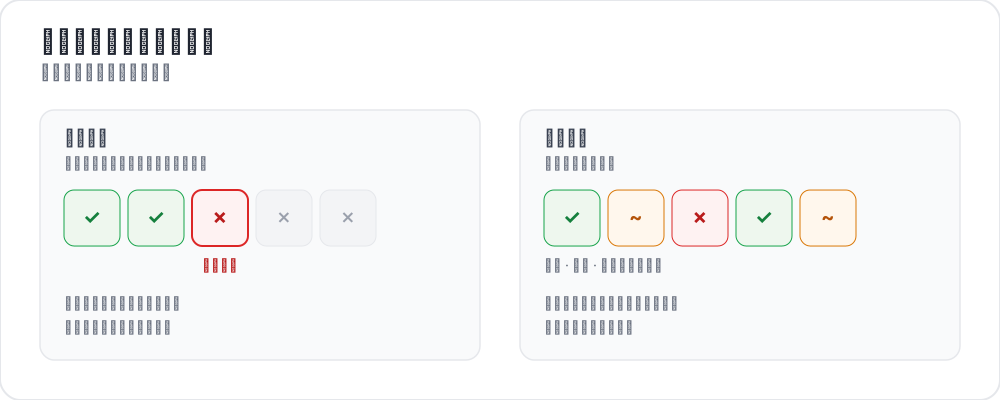 标注过程奖励的两种方式
结果奖励模型(ORM)只看编码智能体轨迹的结尾:代码编译过了吗,测试跑通了吗,问题解决了吗。过程奖励模型(PRM)则给每一个中间步骤打分。每一步都有奖励信号,训练方法就能定位智能体是从哪里开始走错的,这往往让学习更省样本,也有助于泛化。
近期的工作正朝这个方向推进。AgentPRM 为智能体任务重新定义了过程奖励:每个动作按它把任务推进到离目标多近来打分,而不是按对错,论文报告的算力效率比其对比的基线高出 8 倍以上。ToolRM 发现,在自然语言输出上训练的奖励模型判断工具调用的能力很差,于是构建了面向工具的奖励模型,以及用来评测它们的 FC-RewardBench。作为对照,DeepSWE 只用一个稀疏的结果奖励(测试是否通过)来训练编码智能体,在 SWE-bench Verified 上达到 Pass@1 42.2%,配合测试时扩展达到 59%。过程监督想要改进的,正是这种只看结果的设置。
这些方法共同需要的是高质量的步骤级人工标注,而这通常就是瓶颈。Potato 的过程奖励方案就是为了让这类数据收集得更快。底层方案见轨迹评估文档,trace 输入格式的细节见智能体 trace 文档。
两种标注模式
Potato 提供两种 PRM 标注模式,在速度和粒度之间做取舍。按你的数据预算和目标挑一种。
首错模式
在首错模式下,标注者从上到下读完轨迹,点击智能体第一次出错的那一步。Potato 随后把这一步之前的所有步骤标为正确,把这一步及之后的所有步骤标为错误。
这种方式快,因为标注者只需要找一个决策点。当错误会连锁传播时它很好用,也就是说智能体一旦走偏就很少能自己回来,而这在实际中是常态。
annotation_schemes:
  - annotation_type: process_reward
    name: prm_first_error
    mode: "first_error"
    description: >
      Review the agent's steps from top to bottom. Click on the
      first step where the agent makes a mistake. All steps before
      your selection will be marked correct; all steps after
      (including the selected step) will be marked incorrect.
首错标注的流程是这样的:
- 标注者打开一条 trace,看到所有步骤由 CodingTraceDisplay 组件渲染出来。
- 他们按顺序读完这些步骤,查看 diff、终端输出和推理过程。
- 找到第一个错误步骤时,点击它旁边的错误标记。
- 第 0 步到第 N-1 步变绿(正确),第 N 步到结尾变红(错误)。
- 标注者检查自动打上的标签,点击 “Submit” 确认。
如果整条 trace 都正确(智能体完美解决了任务),标注者点 “All Correct”。如果第一步就已经错了,就点第 0 步或者用 “All Incorrect”。
下面是 PRM 标注界面的实际样子:
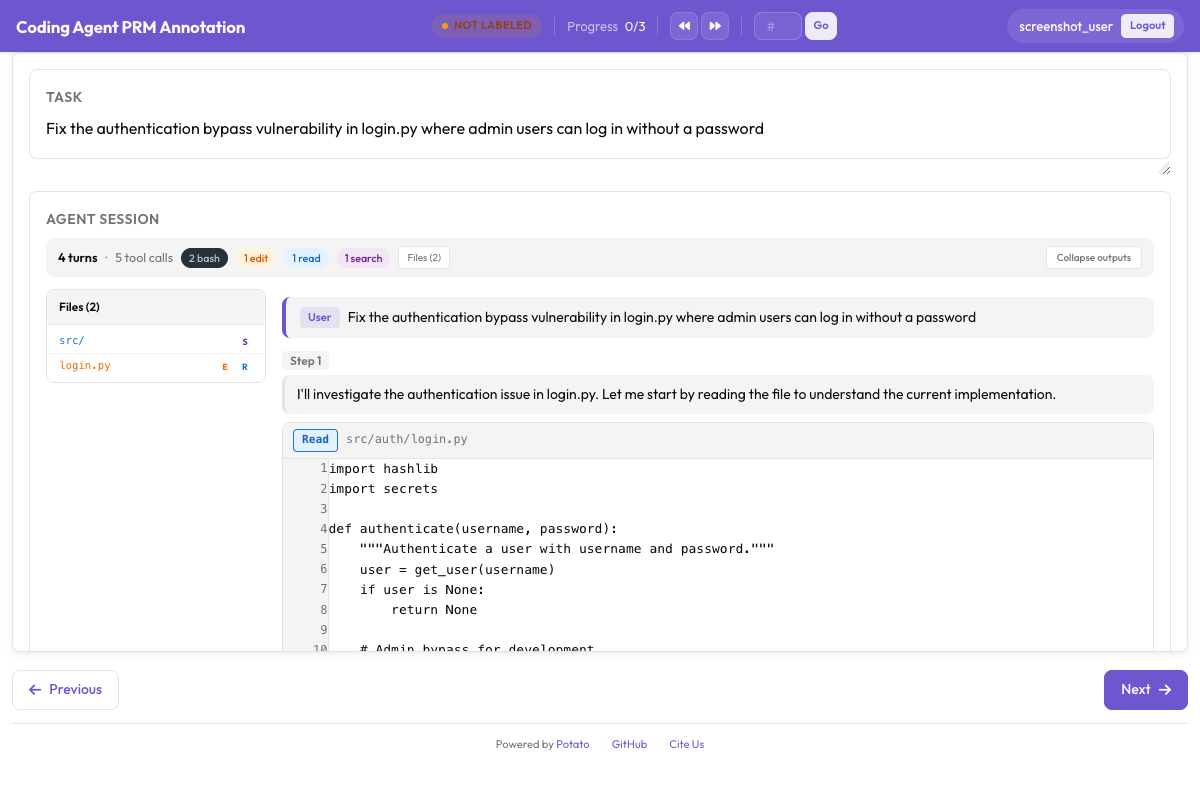 在首错模式下,点击第一个错误步骤,后续步骤会自动标记
逐步模式
在逐步模式下,每一步都有自己的标签。这样得到的数据更丰富,因为它能记录智能体从错误中部分恢复、绕了一段无害但没必要的路,或者某一步本身没问题但放在上下文里是错的这类情况。
annotation_schemes:
  - annotation_type: process_reward
    name: prm_per_step
    mode: "per_step"
搭建一个 PRM 标注项目
第 1 步:准备 trace 数据
输入数据应该是一个 JSONL 文件,每一行是一个包含智能体轨迹的 JSON 对象。关键字段是 id、issue_description 和 structured_turns:
{
  "id": "trace_001",
  "issue_description": "Fix the TypeError in parse_config() when config file is empty",
  "repo": "myorg/myproject",
  "base_commit": "a1b2c3d",
  "structured_turns": [
    {
      "step_idx": 0,
      "type": "thinking",
      "content": "I need to understand what parse_config does and where the TypeError occurs. Let me read the file first."
    },
    {
      "step_idx": 1,
      "type": "file_read",
      "path": "src/config.py",
      "content": "def parse_config(path):\n    with open(path) as f:\n        data = json.load(f)\n    return data['settings']",
      "start_line": 1,
      "end_line": 4
    },
    {
      "step_idx": 2,
      "type": "thinking",
      "content": "The bug is on line 4. When the file is empty, json.load returns None, and None['settings'] raises TypeError. I should add a check."
    },
    {
      "step_idx": 3,
      "type": "file_edit",
      "path": "src/config.py",
      "diff": "--- a/src/config.py\n+++ b/src/config.py\n@@ -1,4 +1,6 @@\n def parse_config(path):\n     with open(path) as f:\n         data = json.load(f)\n+    if data is None:\n+        return {}\n     return data['settings']"
    },
    {
      "step_idx": 4,
      "type": "bash_command",
      "command": "python -m pytest tests/test_config.py -v",
      "output": "tests/test_config.py::test_parse_config_empty PASSED\ntests/test_config.py::test_parse_config_valid PASSED\n\n2 passed in 0.12s",
      "exit_code": 0
    }
  ]
}
如果你要从已有的智能体格式转换过来,用 trace 转换工具:
# Convert Claude Code traces
potato convert-traces \
  --format claude_code \
  --input ./raw_traces/ \
  --output ./data/traces.jsonl

# Convert SWE-Agent trajectories
potato convert-traces \
  --format swe_agent \
  --input ./swe_agent_output/ \
  --output ./data/traces.jsonl
Potato 渲染编码智能体 trace 时会正确高亮 diff:
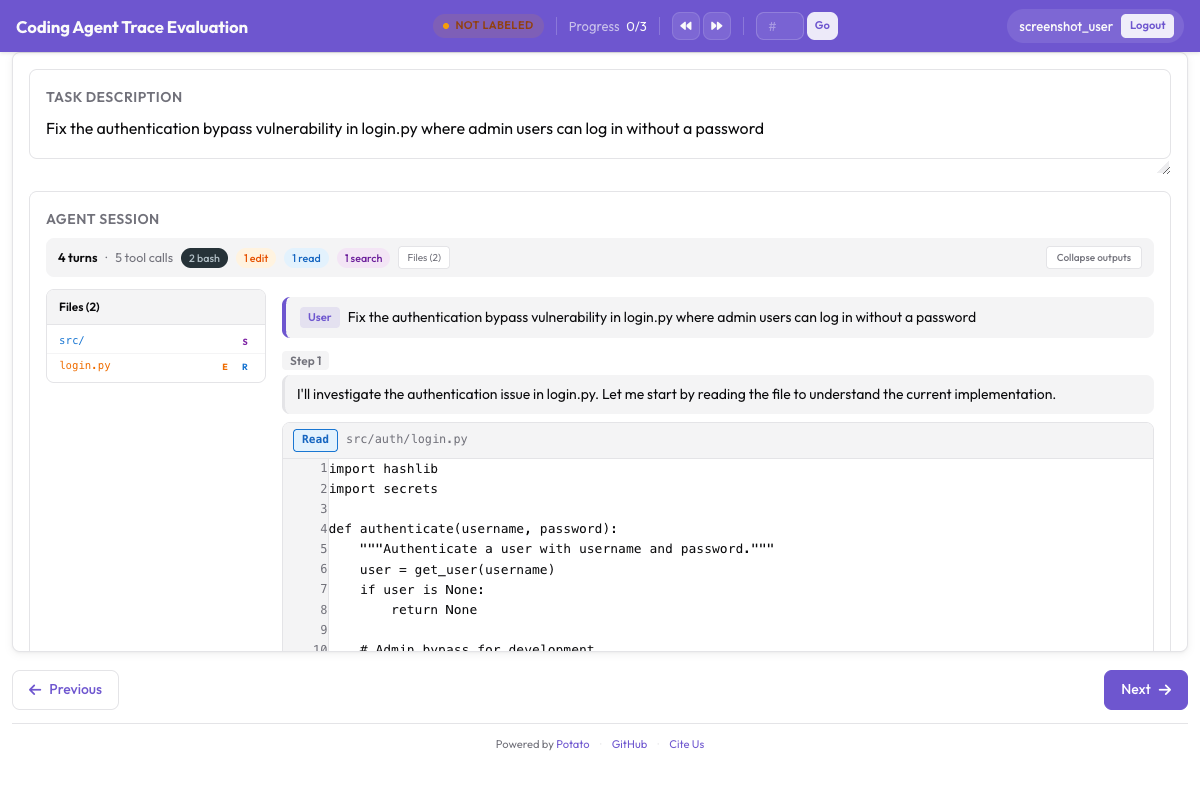 代码 diff、终端输出和文件读取都带语法高亮渲染
第 2 步:写配置文件
下面是一份用首错模式做 PRM 标注的完整项目配置:
# config.yaml
project_name: "PRM Data Collection - SWE-bench Traces"
port: 8000

data:
  source: "local"
  input_path: "./data/traces.jsonl"
  data_format: "coding_trace"

coding_agent:
  display:
    diff_style: "unified"
    context_lines: 3
    syntax_highlighting: true
    terminal_theme: "dark"
    file_tree:
      enabled: true
      position: "left"
    collapsible:
      auto_collapse_thinking: true
      auto_collapse_long_output: true
      long_output_threshold: 50

annotation_schemes:
  - annotation_type: process_reward
    name: step_reward
    mode: "first_error"
    description: >
      Review the agent's trajectory step by step. Click the first
      step where the agent makes an error. If the entire trajectory
      is correct, click "All Correct."

  - annotation_type: radio
    name: outcome
    labels:
      - value: "resolved"
        text: "Fully Resolved"
      - value: "partial"
        text: "Partially Resolved"
      - value: "not_resolved"
        text: "Not Resolved"

  - annotation_type: text
    name: error_description
    description: "If incorrect, briefly describe the error"
    placeholder: "e.g., Agent edited the wrong file..."

output:
  path: "./output/"
  format: "jsonl"

quality_control:
  inter_annotator_agreement: true
  overlap_percentage: 15
  minimum_time_per_instance: 20

annotators:
  - username: "reviewer1"
  - username: "reviewer2"
  - username: "reviewer3"
第 3 步:启动标注服务
# Start the annotation server
potato start config.yaml -p 8000

# Or run in the background
nohup potato start config.yaml -p 8000 > potato.log 2>&1 &
打开 http://localhost:8000,用配置里的任一标注者账号登录,就可以开始审阅 trace 了。
第 4 步:跟踪进度
标注进行期间,随时查看进度和一致性:
# Check annotation progress
potato status config.yaml

# View inter-annotator agreement
potato agreement config.yaml --metric krippendorff_alpha
导出到训练格式
标注完成后,按训练流水线需要的格式导出数据。
用于奖励模型训练的 PRM 格式
PRM 导出格式为每条 trace 生成一个带步骤级标签的 JSON 对象:
potato export \
  --format prm \
  --project ./output/ \
  --output ./training_data/prm_labels.jsonl
输出长这样:
{
  "trace_id": "trace_001",
  "issue_description": "Fix the TypeError in parse_config() when config file is empty",
  "total_steps": 5,
  "first_error_step": null,
  "all_correct": true,
  "steps": [
    {"step_idx": 0, "type": "thinking", "label": "correct", "reward": 1.0},
    {"step_idx": 1, "type": "file_read", "label": "correct", "reward": 1.0},
    {"step_idx": 2, "type": "thinking", "label": "correct", "reward": 1.0},
    {"step_idx": 3, "type": "file_edit", "label": "correct", "reward": 1.0},
    {"step_idx": 4, "type": "bash_command", "label": "correct", "reward": 1.0}
  ]
}
DPO/RLHF 偏好对
当同一个问题有多条 trace 时(比如来自不同智能体或不同次运行),Potato 可以基于 PRM 标签生成偏好对:
potato export \
  --format preference_pairs \
  --project ./output/ \
  --output ./training_data/preferences.jsonl \
  --pair_by "issue_id"
偏好对导出会比较尝试同一任务的多条 trace,按步骤级标签选出更好的那一条:
{
  "prompt": "Fix the TypeError in parse_config() when config file is empty",
  "chosen_trace_id": "trace_001",
  "rejected_trace_id": "trace_002",
  "chosen_first_error": null,
  "rejected_first_error": 3,
  "chosen_steps": 5,
  "rejected_steps": 7,
  "margin": 0.8
}
SWE-bench 兼容结果
导出成 SWE-bench 格式用于基准测试:
potato export \
  --format swe_bench \
  --project ./output/ \
  --output ./training_data/swe_bench_results.json
分析示例
收集完标注之后,可以用下面这些 Python 片段分析数据、找出规律。
按步骤类型统计步骤级准确率
import json
from collections import defaultdict

# Load PRM annotations
with open("training_data/prm_labels.jsonl") as f:
    traces = [json.loads(line) for line in f]

# Compute accuracy by step type
type_stats = defaultdict(lambda: {"correct": 0, "total": 0})

for trace in traces:
    for step in trace["steps"]:
        step_type = step["type"]
        type_stats[step_type]["total"] += 1
        if step["label"] == "correct":
            type_stats[step_type]["correct"] += 1

print("Step-Level Accuracy by Type:")
print("-" * 45)
for step_type, stats in sorted(type_stats.items()):
    acc = stats["correct"] / stats["total"] * 100
    print(f"  {step_type:<20} {acc:5.1f}%  ({stats['correct']}/{stats['total']})")
找出常见的失败点
import json
from collections import Counter

with open("training_data/prm_labels.jsonl") as f:
    traces = [json.loads(line) for line in f]

# Analyze where errors first occur
error_positions = []
error_types_at_first_error = Counter()

for trace in traces:
    if trace["first_error_step"] is not None:
        pos = trace["first_error_step"]
        total = trace["total_steps"]
        # Normalize position to 0-1 range
        error_positions.append(pos / total)
        # Track what type of step caused the first error
        error_step = trace["steps"][pos]
        error_types_at_first_error[error_step["type"]] += 1

if error_positions:
    avg_pos = sum(error_positions) / len(error_positions)
    print(f"Average first-error position: {avg_pos:.2f} (0=start, 1=end)")
    print(f"Traces with errors: {len(error_positions)}/{len(traces)}")
    print()
    print("Most common step types at first error:")
    for step_type, count in error_types_at_first_error.most_common(5):
        print(f"  {step_type}: {count}")
计算 PRM 标签的标注者间一致性
import json
import numpy as np
from sklearn.metrics import cohen_kappa_score

def load_annotations(annotator_file):
    """Load annotations from a single annotator's output file."""
    with open(annotator_file) as f:
        data = {item["trace_id"]: item for item in
                (json.loads(line) for line in f)}
    return data

ann1 = load_annotations("output/reviewer1/annotations.jsonl")
ann2 = load_annotations("output/reviewer2/annotations.jsonl")

# Find overlapping traces
overlap_ids = set(ann1.keys()) & set(ann2.keys())
print(f"Overlapping traces: {len(overlap_ids)}")

# Compare first-error step labels
labels1 = []
labels2 = []
for trace_id in overlap_ids:
    fe1 = ann1[trace_id].get("first_error_step", -1)
    fe2 = ann2[trace_id].get("first_error_step", -1)
    # Bin into: all_correct, early_error (first half), late_error (second half)
    total = ann1[trace_id]["total_steps"]
    for fe, labels in [(fe1, labels1), (fe2, labels2)]:
        if fe is None or fe == -1:
            labels.append("all_correct")
        elif fe < total / 2:
            labels.append("early_error")
        else:
            labels.append("late_error")

kappa = cohen_kappa_score(labels1, labels2)
print(f"Cohen's kappa (binned first-error): {kappa:.3f}")
高效收集 PRM 数据的几点建议
要快就用首错模式。如果你训练 PRM 是为了引导搜索(MCTS、best-of-N 采样),首错模式给的信号已经够用,而标注速度是逐步模式的 2 到 3 倍。反正大多数智能体的失败都是连锁式的:一步错,后面一串都跟着错。
需要细节时用逐步模式。如果你在意部分恢复、无害的绕路,或者你要训练一个标签多于两类的步骤级奖励模型,逐步模式多花的时间是值得的。
把 PRM 和成对比较结合。先用 PRM 单独标注每条 trace,再对尝试同一个问题的 trace 做一次成对比较。一轮标注同时拿到步骤级奖励和偏好对。
先找有经验的标注者。PRM 标注要读代码、diff 和终端输出。先从一小组有经验的开发者开始,量一下一致性,用样例校准过,再扩大规模。
设一个每条数据的最短时间。trace 会变得很复杂。30 秒的下限能防止标注者不看改动就一路点下去。这个值按你的平均 trace 长度调。
准备校准样例。正式标注之前,让所有人标同样的 10 到 20 条 trace,然后一起过一遍分歧在哪。这对一致性影响很大。