Per-Step Error Localization: Using Trajectory Evaluation to Find Where Agents Fail
Use Potato's trajectory_eval schema for per-step error localization with hierarchical error taxonomies, severity scoring, and running score tracking across agent traces.
Pass rates and failure modes
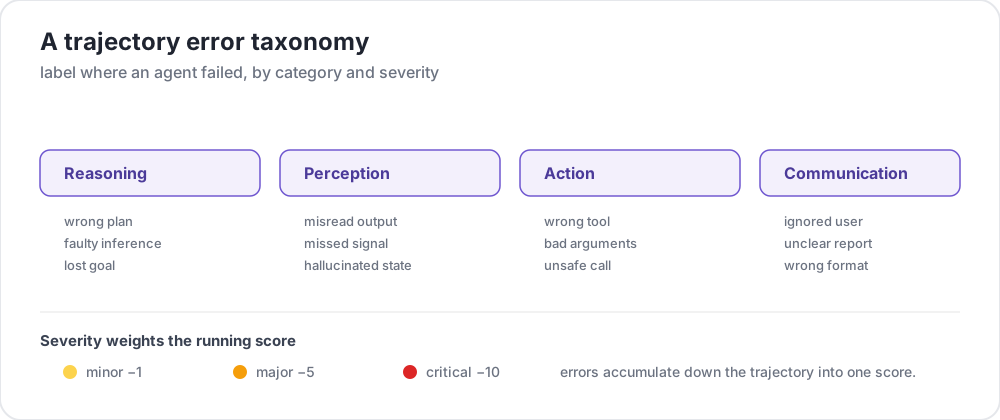 A trajectory error taxonomy
You run your agent on a benchmark. It scores 63% on task completion. Now what?
A pass/fail number tells you the agent failed on 37% of tasks and nothing else. It doesn't tell you where in the trace things went wrong, what type of error the agent made, or how bad it was. Was it a single catastrophic mistake on step 2, or fifteen steps of minor reasoning errors piling up? Did the agent misuse a tool, or reason from a false premise?
Without per-step error localization, you can't diagnose failure modes, decide what to fix first, or build training data for process reward models.
Potato's trajectory_eval annotation schema fixes this. Annotators walk through each step of a trace and record:
- Correctness: Is this step correct or incorrect?
- Error type: Selected from a hierarchical taxonomy you define
- Severity level: Minor, major, or critical, with configurable score weights
- Rationale: Free-text explanation of the error (optional)
- Running score: A cumulative score that decrements based on severity, giving you a per-trace quality curve
This guide covers the full setup: defining your error taxonomy, running the annotation, and analyzing the collected data. For the schema's configuration reference, see the source documentation.
Trajectory eval schema overview
The trajectory_eval schema is built for evaluating multi-step agent traces in sequence. Instead of a single overall quality rating, it produces a structured error annotation for every step, so you end up with a detailed map of where and why the agent failed.
At each step, the annotator:
- Sees the current step content (thought, action, observation, code, etc.)
- Marks the step as correct or incorrect
- If incorrect, selects an error type from the hierarchical taxonomy
- They assign a severity level (minor, major, or critical)
- Optionally, they write a rationale explaining the error
- The running score at the top of the interface updates automatically
The annotator moves through the trace one step at a time, and the labels add up to an error profile for the whole run.
The trajectory evaluation interface shows each step with its score:
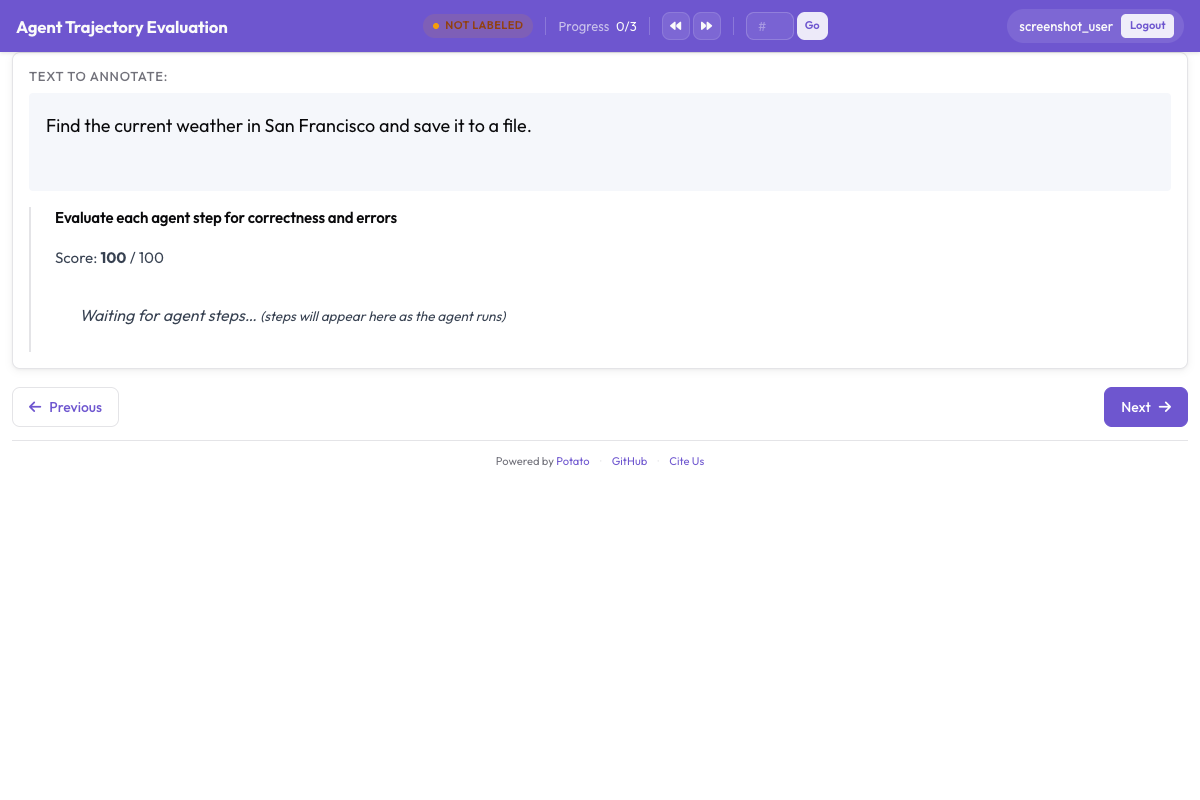 Each step gets a correctness rating, error type, and severity level with a running score that decrements based on severity
Designing a hierarchical error taxonomy
Your taxonomy decides whether the labels aggregate into anything. Get it right and you can pool errors across traces and spot systematic failure patterns. Here is one I'd start from, with four top-level categories.
Reasoning errors
These happen when the agent's reasoning is flawed, even if what it sees and does is otherwise fine.
| Error Type | Description | Example |
|---|---|---|
logical_error | Invalid logical inference | "Since A implies B, and B is true, A must be true" (affirming the consequent) |
incorrect_assumption | Assumes something not supported by evidence | Assumes a file exists without checking |
over_generalization | Draws too broad a conclusion from limited evidence | "This function failed once, so the entire API is broken" |
circular_reasoning | Conclusion is used as a premise | "The answer is X because X is correct" |
incorrect_calculation | Mathematical or logical computation error | Off-by-one error in loop bound reasoning |
Perception errors
These happen when the agent misreads, misinterprets, or misses information in its observations.
| Error Type | Description | Example |
|---|---|---|
missed_element | Fails to notice relevant information | Overlooks an error message in terminal output |
misidentified_element | Misinterprets what it sees | Reads a 404 error as a successful response |
hallucinated_element | Refers to something not present | References a function parameter that does not exist |
outdated_reference | Uses stale information from a previous step | Uses a variable value that was overwritten |
Action errors
These happen when the agent takes the wrong action, or the right action the wrong way.
| Error Type | Description | Example |
|---|---|---|
wrong_tool | Selects an inappropriate tool for the task | Uses grep when find is needed |
wrong_arguments | Correct tool but incorrect parameters | Passes wrong file path to an edit command |
premature_termination | Stops before the task is complete | Returns an answer after finding partial information |
unnecessary_action | Takes an action that adds no value | Re-reads a file that was just read |
destructive_action | Takes an action that causes harm | Deletes a file without backup |
Communication errors
These show up in the agent's responses to users or in how it narrates its own work.
| Error Type | Description | Example |
|---|---|---|
unclear_explanation | Explanation is confusing or ambiguous | Describes a fix without saying what was broken |
missing_context | Omits critical context from response | Reports success without mentioning caveats |
incorrect_summary | Summary does not match actual actions | Claims to have edited 3 files when only 2 were changed |
overconfident_claim | States uncertainty as certainty | "This will definitely fix the issue" for an untested change |
Severity levels and score weights
Each error gets a severity level. The default weights are:
| Severity | Weight | Description |
|---|---|---|
minor | -1 | Small issues that do not derail the trace (e.g., unnecessary action, unclear explanation) |
major | -5 | Significant errors that waste effort or produce partially wrong results (e.g., wrong tool, incorrect assumption) |
critical | -10 | Errors that fundamentally break the trace (e.g., destructive action, premature termination with wrong answer) |
The running score starts at 100 and drops by the severity weight at each error. A trace that ends at 85 had a few minor issues; one that ends at 40 had several major failures.
You can change these weights in the configuration:
severity_levels:
  - name: minor
    weight: -1
    description: "Small issue, does not derail the overall trace"
  - name: major
    weight: -5
    description: "Significant error that wastes effort or produces wrong intermediate results"
  - name: critical
    weight: -10
    description: "Fundamental failure that breaks the trace or causes harm"
Full YAML configuration
Here is a complete config.yaml for trajectory evaluation with the full taxonomy:
annotation_task_name: "Agent Trajectory Error Localization"

data_files:
  - "data/traces.jsonl"

item_properties:
  id_key: "trace_id"
  text_key: "task"

# Display agent traces with step-by-step rendering
display:
  type: "agent_trace"
  trace_key: "trace"
  step_display:
    thought: { label: "Thought", color: "#E8F0FE" }
    action: { label: "Action", color: "#FFF3E0" }
    observation: { label: "Observation", color: "#F1F8E9" }
    code: { label: "Code", color: "#F3E5F5" }

annotation_schemes:
  - annotation_type: "trajectory_eval"

    # Per-step correctness check

    # Hierarchical error taxonomy (shown when step is marked incorrect)

      - category: "perception"
        label: "Perception Error"
        types:
          - name: "missed_element"
            label: "Missed Element"
            description: "Fails to notice relevant information in observations"
          - name: "misidentified_element"
            label: "Misidentified Element"
            description: "Misinterprets what it observes"
          - name: "hallucinated_element"
            label: "Hallucinated Element"
            description: "Refers to something not present in the context"
          - name: "outdated_reference"
            label: "Outdated Reference"
            description: "Uses stale information from a previous step"

      - category: "action"
        label: "Action Error"
        types:
          - name: "wrong_tool"
            label: "Wrong Tool"
            description: "Selects an inappropriate tool for the task"
          - name: "wrong_arguments"
            label: "Wrong Arguments"
            description: "Correct tool but incorrect parameters"
          - name: "premature_termination"
            label: "Premature Termination"
            description: "Stops before the task is complete"
          - name: "unnecessary_action"
            label: "Unnecessary Action"
            description: "Takes an action that adds no value"
          - name: "destructive_action"
            label: "Destructive Action"
            description: "Takes an action that causes harm or data loss"

      - category: "communication"
        label: "Communication Error"
        types:
          - name: "unclear_explanation"
            label: "Unclear Explanation"
            description: "Explanation is confusing or ambiguous"
          - name: "missing_context"
            label: "Missing Context"
            description: "Omits critical context from the response"
          - name: "incorrect_summary"
            label: "Incorrect Summary"
            description: "Summary does not match the actual actions taken"
          - name: "overconfident_claim"
            label: "Overconfident Claim"
            description: "States uncertain outcomes as certainties"

    # Severity levels with score weights

    # Running score configuration

    # Optional rationale field

  # Overall trace quality (optional, shown at the end)
  - annotation_type: "radio"

# Annotator settings
annotator_config:
  allow_back_navigation: true
  require_all_steps: true

# Output settings
output:
  path: "output/"
  format: "jsonl"
Step-by-step setup
1. Prepare your agent traces
Trace data goes in JSONL format, one trace per line. Each trace needs an ID, a task description, and a list of steps:
{
  "trace_id": "trace_042",
  "task": "Find the bug in the calculate_discount function and fix it",
  "trace": [
    {
      "type": "thought",
      "content": "I need to look at the calculate_discount function to find the bug. Let me search for it."
    },
    {
      "type": "action",
      "content": "search",
      "action_input": "def calculate_discount"
    },
    {
      "type": "observation",
      "content": "Found in pricing.py line 45:\ndef calculate_discount(price, discount_pct):\n    return price * discount_pct / 100"
    },
    {
      "type": "thought",
      "content": "The function calculates the discount amount but doesn't subtract it from the price. It should return price - (price * discount_pct / 100)."
    },
    {
      "type": "action",
      "content": "edit_file",
      "action_input": "pricing.py:45: return price - (price * discount_pct / 100)"
    },
    {
      "type": "observation",
      "content": "File edited successfully."
    },
    {
      "type": "action",
      "content": "finish",
      "action_input": "Fixed the calculate_discount function. It was returning the discount amount instead of the discounted price."
    }
  ]
}
If your traces are in a different format (OpenAI messages, LangChain runs, Claude conversation logs), use the Potato trace converter:
python -m potato.trace_converter \
  --input raw_traces/ \
  --output data/traces.jsonl \
  --input-format react
2. Configure your taxonomy
Start with the full taxonomy above, then trim or extend it for your agent. For a coding agent, for instance, you might add a code_quality category:
- category: "code_quality"
  label: "Code Quality Error"
  types:
    - name: "syntax_error"
      label: "Syntax Error"
      description: "Generated code has syntax errors"
    - name: "runtime_error"
      label: "Runtime Error"
      description: "Code runs but produces an error"
    - name: "logic_bug"
      label: "Logic Bug"
      description: "Code runs without errors but produces wrong output"
    - name: "style_violation"
      label: "Style Violation"
      description: "Code works but violates project conventions"
For coding agent traces, the evaluation renders diffs and terminal output alongside the scoring:
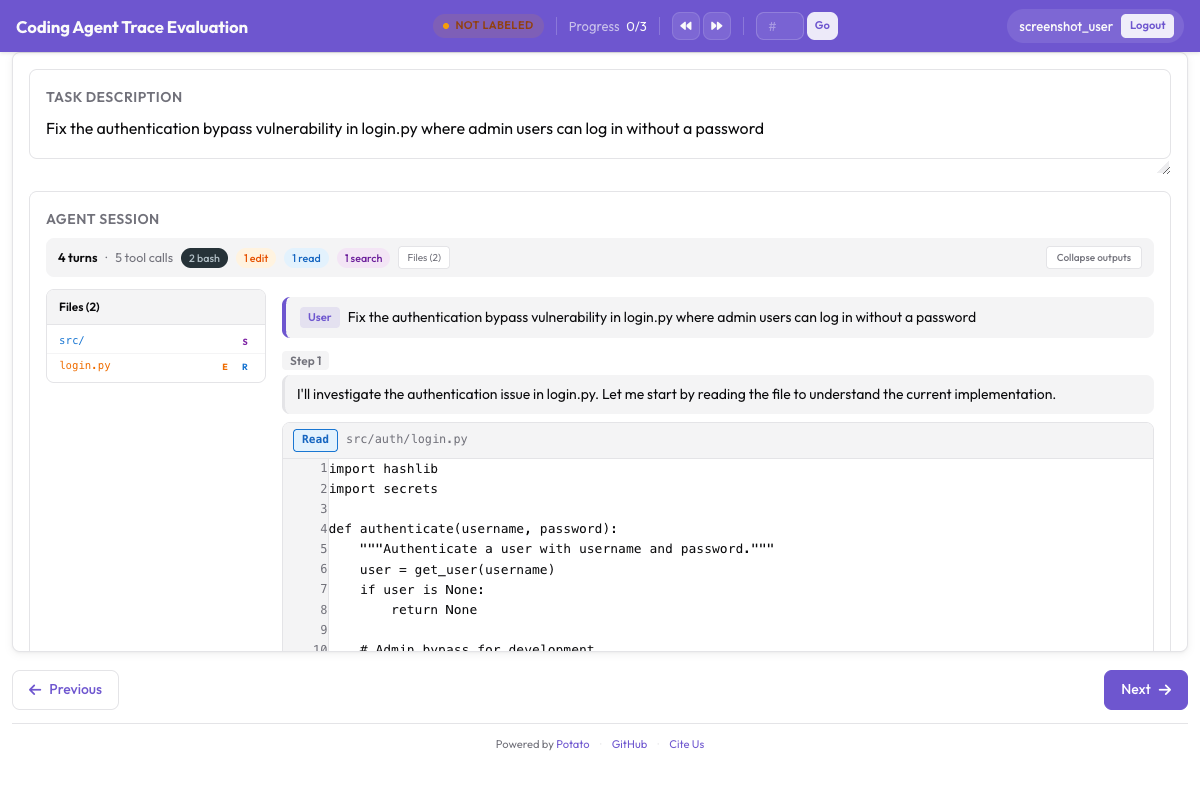 CodingTraceDisplay renders diffs, terminal blocks, and file reads alongside trajectory evaluation controls
3. Launch the annotation server
potato start config.yaml -p 8000Open http://localhost:8000 in your browser. You will see the first trace with the step-by-step display.
4. Write annotation guidelines
Give annotators clear instructions. At a minimum, document:
- When to mark a step as incorrect vs. correct-but-suboptimal
- How to choose between error categories when multiple apply (use the most specific one)
- When to assign each severity level, with concrete examples
- Whether to evaluate steps based on information available at that step or with hindsight
The annotation workflow
When an annotator opens a trace, the task description sits at the top and the first step is below it. The running score reads 100 in the top-right corner.
For each step, the annotator:
- Reads the step content in context of previous steps
- Marks correctness by clicking "Correct" or "Incorrect"
- If incorrect, selects the error category (e.g., "Reasoning Error") and then the specific type (e.g., "Incorrect Assumption")
- Assigns severity: minor, major, or critical
- Writes a rationale (if enabled): "The agent assumes the file is in the current directory without checking, but the search results showed it is in src/utils/"
- Advances to the next step by clicking "Next Step" or pressing the right arrow key
The running score updates after each error. Mark step 3 as a major error (-5) and the score drops from 100 to 95. Mark step 7 critical (-10) and it falls to 85.
At the end of the trace, the annotator gives the overall success/partial/failure rating and submits.
Analyzing the results
Loading annotation data
import json
import pandas as pd
from collections import Counter
from pathlib import Path

# Load all annotation files
annotations = []
output_dir = Path("output/")
for f in output_dir.glob("*.jsonl"):
    with open(f) as fh:
        for line in fh:
            annotations.append(json.loads(line))

print(f"Loaded {len(annotations)} annotated traces")
Error distribution analysis
# Extract all errors across all traces
errors = []
for ann in annotations:
    for step_ann in ann.get("error_localization", []):
        if step_ann["correctness"] == "incorrect":
            errors.append({
                "trace_id": ann["trace_id"],
                "step_index": step_ann["step_index"],
                "category": step_ann["error_category"],
                "error_type": step_ann["error_type"],
                "severity": step_ann["severity"],
                "rationale": step_ann.get("rationale", ""),
            })

error_df = pd.DataFrame(errors)
print(f"Total errors found: {len(error_df)}")
print()

# Error distribution by category
print("Errors by category:")
print(error_df["category"].value_counts())
print()

# Most common specific error types
print("Top 10 error types:")
print(error_df["error_type"].value_counts().head(10))
print()

# Severity distribution
print("Severity distribution:")
print(error_df["severity"].value_counts())
Error position analysis
Seeing where in a trace errors tend to land often reveals systematic patterns:
import matplotlib.pyplot as plt
import numpy as np

# Normalize step positions to [0, 1] range
for ann in annotations:
    trace_length = len(ann.get("error_localization", []))
    for step_ann in ann["error_localization"]:
        if step_ann["correctness"] == "incorrect":
            step_ann["normalized_position"] = step_ann["step_index"] / max(trace_length - 1, 1)

# Collect normalized positions
positions = [
    step_ann["normalized_position"]
    for ann in annotations
    for step_ann in ann.get("error_localization", [])
    if step_ann["correctness"] == "incorrect"
    and "normalized_position" in step_ann
]

plt.figure(figsize=(10, 4))
plt.hist(positions, bins=20, edgecolor="black", alpha=0.7)
plt.xlabel("Normalized Position in Trace (0 = start, 1 = end)")
plt.ylabel("Error Count")
plt.title("Where Do Agent Errors Occur?")
plt.tight_layout()
plt.savefig("error_position_distribution.png", dpi=150)
print("Saved error_position_distribution.png")
Running score distributions
# Extract final running scores
final_scores = []
for ann in annotations:
    score = 100
    severity_weights = {"minor": -1, "major": -5, "critical": -10}
    for step_ann in ann.get("error_localization", []):
        if step_ann["correctness"] == "incorrect":
            score += severity_weights.get(step_ann["severity"], 0)
    score = max(score, 0)
    final_scores.append({
        "trace_id": ann["trace_id"],
        "final_score": score,
        "overall_success": ann.get("overall_success", "unknown"),
    })

score_df = pd.DataFrame(final_scores)

print("Score statistics:")
print(score_df["final_score"].describe())
print()

# Score distribution by overall success
for label in ["success", "partial", "failure"]:
    subset = score_df[score_df["overall_success"] == label]
    if len(subset) > 0:
        print(f"{label}: mean={subset['final_score'].mean():.1f}, "
              f"median={subset['final_score'].median():.1f}, "
              f"n={len(subset)}")
Most common failure modes
# Group errors by category + type for a failure mode analysis
failure_modes = (
    error_df.groupby(["category", "error_type"])
    .agg(
        count=("severity", "size"),
        avg_severity_weight=("severity", lambda x: x.map(
            {"minor": 1, "major": 5, "critical": 10}
        ).mean()),
    )
    .sort_values("count", ascending=False)
)

print("Top failure modes (by frequency):")
print(failure_modes.head(15).to_string())
print()

# Impact-weighted failure modes (frequency x average severity)
failure_modes["impact"] = failure_modes["count"] * failure_modes["avg_severity_weight"]
print("Top failure modes (by impact):")
print(failure_modes.sort_values("impact", ascending=False).head(10).to_string())
Research context
Per-step error localization lines up with a few recent threads in agent evaluation:
TRAIL (Patronus AI, 2025) annotated 148 agent traces from GAIA and SWE-bench Lite against a taxonomy of more than 20 error types, 841 errors in total. The result worth noting is how hard localization turned out to be: the best long-context reasoning model they tested reached 11% joint accuracy on error category plus location. That is the job trajectory_eval hands to human annotators, and it is why the labels are worth paying for.
AgentRewardBench (McGill NLP, 2025) went after the judges instead. It collects 1,302 web-agent trajectories across five benchmarks, has an expert review each one for success, side effects, and repetition, and then scores twelve LLM judges against those reviews. No judge led on every benchmark, and the rule-based evaluations the benchmarks ship with underreported how often agents actually succeeded. If you plan to automate part of this taxonomy with a model, that is the shape of the check you need.
The step-level correctness and severity labels from trajectory_eval also feed process reward model training directly: each annotated step is a training example with a ground-truth quality signal.
Anthropic's Demystifying evals for AI agents makes the operational version of the same argument. Grade the transcript and not only the outcome, and use model-based graders with explicit rubrics for how the agent called tools and talked to the user. It also warns against scoring against a prescribed step sequence, because agents keep finding valid paths the eval designer did not anticipate. Hold onto that when you apply this taxonomy: a step is an error because it was wrong, not because it was unexpected.
The severity-weighted running score also maps onto the reward signals used in RLHF. A score curve that drops sharply at step 5 of a 20-step trace tells you exactly where the agent needs work, which is a lot more actionable than a single end-of-trace reward.
Summary
The trajectory_eval schema turns agent evaluation from a pass/fail check into a diagnostic. With a hierarchical taxonomy, severity scoring, and a running score, you can see which step went wrong, what kind of error it was, how bad it was, and where errors tend to cluster across traces. The step-level labels are also ready to use as process reward model training data.
Start with the full taxonomy in this guide, then refine it for your agent and the error patterns you actually see.