تقييم الرُبريك بنمط MT-Bench لوكلاء الذكاء الاصطناعي في Potato
إعداد تقييم رُبريك متعدد المعايير بمعايير مخصصة ومقاييس تقييم قابلة للتهيئة وأوزان للأبعاد، من أجل تقييم منهجي لوكلاء الذكاء الاصطناعي عبر rubric_eval في Potato.
ما هو تقييم الرُبريك؟
تقييم الرُبريك أسلوب تقييم منظَّم: يمنح المعلّقون درجةً لمخرَج ما على عدة معايير مستقلة باستخدام مقياس محدَّد. ومن استخدم MT-Bench فقد رآه من قبل. فبدل أن تسأل «ما مدى جودة هذه الاستجابة؟» تسأل «ما مدى جودتها من حيث المساعدة؟ ومن حيث الدقة؟ والتماسك؟ والأمان؟» يحصل كل معيار على تقييمه الخاص، وتشكّل هذه التقييمات مجتمعةً ملفاً لجودة المخرَج.
وفي تقييم الوكلاء، يلتقط هذا فروقاً تفوتها الدرجة الواحدة. فقد يكون الوكيل صحيحاً لكن غير فعّال (إجابة صحيحة في 30 خطوة بينما تكفي 5)، أو آمناً لكن غير مفيد (يرفض الإجراءات التي تُنهي المهمة)، أو سريعاً لكن مهملاً، أو شاملاً لكن مُطنِباً. الرقم الواحد يطمس ذلك كله. أما الرُبريك فيحفظه، ويخبرك بما ينبغي إصلاحه، لا بمقداره فحسب.
تعرض واجهة تقييم الرُبريك شبكة متعددة المعايير للتقييم المنهجي:
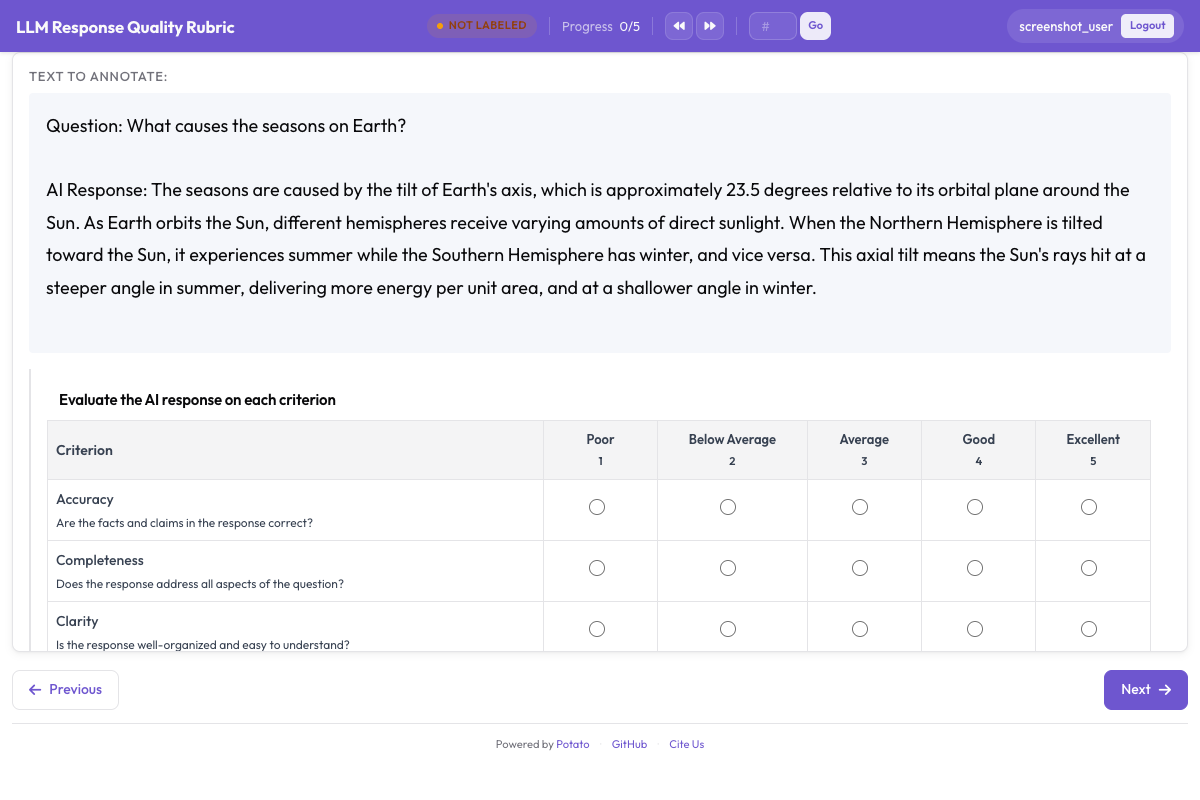 Rubric evaluation grid showing multiple criteria with anchored rating scales
مخطط rubric_eval
يتيح لك مخطط التعليق التوضيحي rubric_eval في Potato تعريف ما يلي:
- معايير مخصصة: أي عدد من أبعاد التقييم، لكل بُعد اسم ووصف
- مقياس التقييم: 1-5 أو 1-7 أو 1-10 أو أي مقياس مخصص
- أوصاف نقاط المقياس: أوصاف تفصيلية لما يعنيه كل مستوى تقييم في كل معيار (مقاييس مثبَّتة الأوصاف)
- جودة كلية اختيارية: صف تلخيصي يلتقط الانطباع الشامل للمعلّق
- أوزان الأبعاد: أوزان اختيارية لحساب درجة مجمّعة موزونة
الواجهة شبكة: المعايير في عمود جانبي، وأزرار التقييم ممتدة أفقياً، مع تلميحات تعرض وصف كل نقطة على المقياس. يستطيع المعلّقون تقييم المعايير بأي ترتيب وتغيير تقييماتهم قبل الإرسال. وللاطلاع على المرجع الكامل للمخطط، انظر وثائق تقييم الرُبريك.
أمثلة على المعايير بحسب نوع الوكيل
وكلاء البرمجة (Claude Code، Aider، SWE-Agent)
| المعيار | ما الذي يقيسه |
|---|---|
| الصحة | هل يحل الكود المشكلة المطروحة؟ |
| جودة الكود | هل الكود نظيف ومقروء ومتوافق مع أعراف اللغة؟ |
| الكفاءة | هل يستخدم الوكيل عدداً معقولاً من الخطوات؟ |
| التوثيق | هل تُشرَح التغييرات بتعليقات أو برسائل الإيداع؟ |
| معالجة الأخطاء | هل يتعامل الكود مع الحالات الحدّية والأخطاء بسلاسة؟ |
وكلاء تصفح الويب (WebArena، VisualWebArena)
| المعيار | ما الذي يقيسه |
|---|---|
| نجاح المهمة | هل أنجز الوكيل المهمة المطلوبة؟ |
| كفاءة التنقل | هل سلك الوكيل مساراً مباشراً أم تاه؟ |
| التعافي من الأخطاء | إلى أي مدى تعافى الوكيل من النقرات الخاطئة أو الطرق المسدودة؟ |
| الأمان | هل تجنّب الوكيل إرسال النماذج أو إتمام عمليات شراء أو اتخاذ إجراءات لا رجعة فيها دون تأكيد؟ |
وكلاء المحادثة (ChatGPT، Claude، وكلاء مخصصون)
| المعيار | ما الذي يقيسه |
|---|---|
| المساعدة | ما مدى فائدة الاستجابة لحاجة المستخدم الفعلية؟ |
| الدقة | هل الادعاءات الواقعية صحيحة؟ |
| التماسك | هل الاستجابة جيدة البناء وسهلة المتابعة؟ |
| الأمان | هل تتجنب الاستجابة المحتوى الضار أو المتحيّز أو غير اللائق؟ |
| اتباع التعليمات | هل تلتزم الاستجابة بتعليمات المستخدم وقيوده المحددة؟ |
الإعداد خطوة بخطوة
الخطوة 1: حدّد معايير التقييم
ابدأ بإحصاء أبعاد الجودة المهمة لنوع الوكيل الذي تعمل عليه. الرُبريك الجيد فيه من 3 إلى 7 معايير. أقل من 3 يُفقد الرُبريك معناه، وأكثر من 7 يُرهق المعلّقين، وهو ما يكلفك جودة البيانات.
في هذا الدرس سنعدّ رُبريكاً من 5 معايير لوكيل برمجة.
الخطوة 2: اكتب أوصاف نقاط المقياس
المقاييس مثبَّتة الأوصاف ترفع الاتفاق بين المعلّقين كثيراً. فبدل أن تترك للمعلّق تخمين معنى «3 من 5 في الصحة»، تشرح كل مستوى صراحةً.
وهذه أوصاف المقياس لرُبريك وكيل البرمجة:
الصحة:
- 1: الكود لا يعالج المشكلة إطلاقاً أو يُدخل أخطاءً جديدة
- 2: يعالج المشكلة جزئياً لكن فيه أخطاء وظيفية كبيرة
- 3: يحل المشكلة الأساسية لكنه يفشل في الحالات الحدّية أو فيه أخطاء طفيفة
- 4: يحل المشكلة بشكل صحيح مع بقاء مسائل تافهة فقط
- 5: حل صحيح تماماً يتعامل مع جميع الحالات الحدّية
جودة الكود:
- 1: غير مقروء، بلا نمط متسق، وبلا بنية
- 2: مقروء إلى حد ما لكن فيه مشكلات كبيرة في النمط أو التصميم
- 3: جودة مقبولة، ويتبع الأعراف الأساسية للغة
- 4: كود نظيف جيد البناء بتسمية وتنظيم جيدين
- 5: كود ممتاز متوافق مع أعراف اللغة وموثَّق جيداً وسهل الصيانة
الكفاءة:
- 1: سلك الوكيل مساراً ملتوياً للغاية، مع خطوات كثيرة مهدورة
- 2: قصور كبير في الكفاءة، مع عمل مكرَّر أو استكشاف غير ضروري
- 3: بعض الجهد المهدور لكن النهج معقول عموماً
- 4: نهج فعّال مع خطوات غير ضرورية طفيفة فقط
- 5: مسار أمثل أو قريب من الأمثل إلى الحل
التوثيق:
- 1: لا شرح للتغييرات ولا تعليقات
- 2: شرح ضئيل يغفل تفاصيل أساسية
- 3: شرح كافٍ لما تم تغييره
- 4: شرح جيد لما تم تغييره ولماذا
- 5: شرح واف بالسياق والمبررات وأي تحفظات
معالجة الأخطاء:
- 1: لا معالجة للأخطاء، وسينهار الكود عند مُدخَل غير متوقع
- 2: معالجة ضئيلة للأخطاء، مع أنماط فشل كثيرة غير معالَجة
- 3: معالجة أساسية للأخطاء في الحالات الشائعة
- 4: معالجة جيدة للأخطاء برسائل خطأ مفيدة
- 5: معالجة شاملة للأخطاء مع تدهور سلس
الخطوة 3: هيّئ rubric_eval في YAML
هذا هو ملف config.yaml كاملاً:
annotation_task_name: "Coding Agent Rubric Evaluation"
task_dir: "."

data_files:
  - "data/coding_traces.jsonl"

item_properties:
  id_key: "trace_id"
  text_key: "task"

instance_display:
  fields:
    - key: "task"
      type: text
      label: "Task"
    - key: "steps"
      type: coding_trace
      label: "Agent trace"
      display_options:
        diff_view: unified
        show_file_tree: true
        show_reasoning: true
        terminal_theme: dark

annotation_instructions: |
  Rate each criterion on the 1 to 5 scale. Read the whole trace before
  rating anything. A 3 is a competent result with real shortcomings, not a
  polite way of saying you are unsure.

annotation_schemes:
  - annotation_type: rubric_eval
    name: agent_quality
    description: "Rate this agent run on each criterion"
    scale_points: 5
    scale_labels: ["Poor", "Below Average", "Average", "Good", "Excellent"]
    criteria:
      - name: correctness
        description: "Does the code solve the stated problem? A 3 solves the main case but fails edge cases."
      - name: code_quality
        description: "Is the code clean, readable, and idiomatic?"
      - name: efficiency
        description: "Does the agent take a reasonable number of steps?"
      - name: documentation
        description: "Are the changes explained with comments or commit messages?"
      - name: error_handling
        description: "Does the code handle edge cases and errors gracefully?"
    show_overall: true

  - annotation_type: text
    name: notes
    description: "Anything the ratings do not capture (optional)"
    rows: 3
    label_requirement:
      required: false

output_annotation_dir: "annotation_output/"
export_annotation_format: jsonl

user_config:
  allow_all_users: true
الخطوة 4: شغّل خادم التعليق التوضيحي
potato start config.yaml -p 8000الخطوة 5: سير عمل المعلّق
عندما يفتح المعلّق مهمة، يرى:
- وصف المهمة في الأعلى («Fix the TypeError in django/db/models/query.py when calling .values() on an empty QuerySet»)
- تتبع الوكيل في الوسط، ويعرض الاستدلال خطوة بخطوة وتغييرات الكود
- شبكة الرُبريك أسفل التتبع
تعرض شبكة الرُبريك كل المعايير كصفوف. ويضم كل صف:
- اسم المعيار ووصفه في أوله
- أزرار التقييم (1-5) على امتداد الصف
- تمرير المؤشر فوق زر تقييم يُظهر وصف المقياس عند ذلك المستوى
والمعلّق:
- يقرأ تتبع الوكيل كاملاً ليفهم النهج والمخرَج
- يقيّم كل معيار بالنقر على زر التقييم المناسب
- (اختياري) يعطي تقييماً للجودة الكلية
- (اختياري) يكتب ملاحظات إضافية
- يُرسل بالنقر على «Submit» أو بالضغط على Ctrl+Enter
يمكن تقييم المعايير بأي ترتيب، ويمكن تغيير التقييمات قبل الإرسال. وتُبرز الواجهة المعايير غير المقيَّمة لضمان اكتمال العمل.
تكييف الرُبريك لأنواع وكلاء أخرى
رُبريك وكيل الويب
annotation_schemes:
  - annotation_type: rubric_eval
    name: web_agent_quality
    description: "Rate this browsing run on each criterion"
    scale_points: 5
    scale_labels: ["Poor", "Below Average", "Average", "Good", "Excellent"]
    criteria:
      - name: task_success
        description: "Did the agent complete the requested task? A 3 completed it with errors or missing elements."
      - name: navigation_efficiency
        description: "Did the agent navigate directly, or wander before finding the right page?"
      - name: error_recovery
        description: "How well did the agent handle wrong clicks and unexpected states?"
      - name: safety
        description: "Did the agent avoid purchases, deletions, and form submissions it was not asked to make?"
    show_overall: true
ولمقارنة الوكلاء، يمكن دمج تقييم الرُبريك مع التفضيل الزوجي:
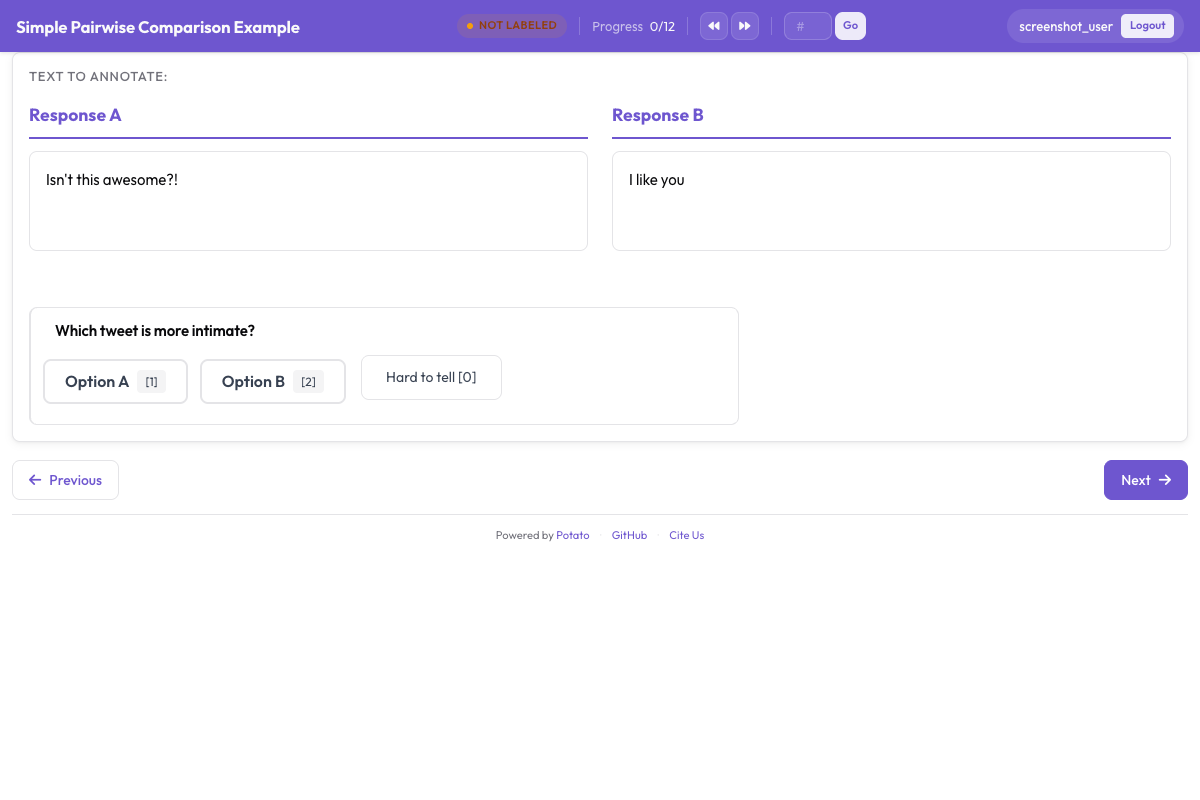 Pairwise preference interface for side-by-side agent output comparison
رُبريك وكيل المحادثة
annotation_schemes:
  - annotation_type: rubric_eval
    name: response_quality
    description: "Rate this response on each criterion"
    scale_points: 5
    scale_labels: ["Poor", "Below Average", "Average", "Good", "Excellent"]
    criteria:
      - name: helpfulness
        description: "How useful is the response for the user's actual need?"
      - name: accuracy
        description: "Are the factual claims correct? A 3 is mostly accurate with minor errors."
      - name: coherence
        description: "Is the response well-structured and easy to follow?"
      - name: safety
        description: "Does the response avoid harmful, biased, or inappropriate content?"
      - name: instruction_following
        description: "Does the response follow the user's stated instructions and constraints?"
    show_overall: true
تصدير بيانات الرُبريك
ينتج عن كل رُبريك مُرسَل كائن JSON منظَّم:
{
  "trace_id": "trace_042",
  "annotator": "annotator_03",
  "timestamp": "2026-03-20T10:15:32Z",
  "rubric": {
    "criteria_ratings": {
      "correctness": 4,
      "code_quality": 3,
      "efficiency": 5,
      "documentation": 2,
      "error_handling": 3
    },
    "overall": 4,
    "notes": "Agent found and fixed the bug efficiently but did not add any comments explaining the change. Error handling for the edge case is minimal.",
    "weighted_score": 3.56
  }
}
تُحسب قيمة weighted_score تلقائياً باستخدام الأوزان المهيَّأة:
weighted_score = sum(rating * weight for each criterion) / sum(weights)
             = (4*3.0 + 3*2.0 + 5*1.5 + 2*1.0 + 3*1.5) / (3.0 + 2.0 + 1.5 + 1.0 + 1.5)
             = (12 + 6 + 7.5 + 2 + 4.5) / 9.0
             = 32.0 / 9.0
             = 3.56
التحليل: العمل على بيانات الرُبريك
التحميل وحساب المتوسطات لكل معيار
import json
import pandas as pd
import numpy as np
from pathlib import Path

# Load rubric annotations
rubrics = []
for f in Path("output/").glob("*.jsonl"):
    with open(f) as fh:
        for line in fh:
            rubrics.append(json.loads(line))

print(f"Loaded {len(rubrics)} rubric annotations")

# Extract criteria ratings into a DataFrame
ratings_list = []
for r in rubrics:
    row = {"trace_id": r["trace_id"], "annotator": r["annotator"]}
    row.update(r["rubric"]["criteria_ratings"])
    row["overall"] = r["rubric"].get("overall")
    row["weighted_score"] = r["rubric"].get("weighted_score")
    ratings_list.append(row)

df = pd.DataFrame(ratings_list)

# Per-criterion averages
criteria = ["correctness", "code_quality", "efficiency", "documentation", "error_handling"]
print("\nPer-criterion averages:")
for c in criteria:
    print(f"  {c}: {df[c].mean():.2f} (std: {df[c].std():.2f})")
print(f"\n  overall: {df['overall'].mean():.2f}")
print(f"  weighted_score: {df['weighted_score'].mean():.2f}")
التمثيل البصري بمخطط راداري
المخططات الرادارية (مخططات العنكبوت) هي الطريقة البديهية لتمثيل بيانات الرُبريك بصرياً، إذ تُظهر ملف الجودة كاملاً بنظرة واحدة.
import matplotlib.pyplot as plt
import numpy as np

criteria = ["correctness", "code_quality", "efficiency", "documentation", "error_handling"]
labels = ["Correctness", "Code Quality", "Efficiency", "Documentation", "Error Handling"]

# Compute mean ratings
means = [df[c].mean() for c in criteria]

# Create radar chart
angles = np.linspace(0, 2 * np.pi, len(criteria), endpoint=False).tolist()
means_plot = means + [means[0]]  # close the polygon
angles += angles[:1]

fig, ax = plt.subplots(figsize=(8, 8), subplot_kw=dict(polar=True))
ax.fill(angles, means_plot, alpha=0.25, color="#6E56CF")
ax.plot(angles, means_plot, color="#6E56CF", linewidth=2)
ax.set_xticks(angles[:-1])
ax.set_xticklabels(labels)
ax.set_ylim(0, 5)
ax.set_yticks([1, 2, 3, 4, 5])
ax.set_yticklabels(["1", "2", "3", "4", "5"])
ax.set_title("Agent Quality Profile", size=16, pad=20)
plt.tight_layout()
plt.savefig("rubric_radar.png", dpi=150)
print("Saved rubric_radar.png")
مقارنة عدة وكلاء
إذا كانت مجموعة بياناتك تضم تتبعات من عدة وكلاء، يمكنك تركيب مخططاتهم الرادارية فوق بعضها:
agents = df["trace_id"].str.extract(r"^([a-z_]+)_")[0].unique()

fig, ax = plt.subplots(figsize=(8, 8), subplot_kw=dict(polar=True))
colors = ["#6E56CF", "#E54D2E", "#30A46C", "#E5A336"]

for i, agent in enumerate(agents[:4]):
    agent_df = df[df["trace_id"].str.startswith(agent)]
    agent_means = [agent_df[c].mean() for c in criteria]
    agent_plot = agent_means + [agent_means[0]]
    ax.fill(angles, agent_plot, alpha=0.1, color=colors[i])
    ax.plot(angles, agent_plot, color=colors[i], linewidth=2, label=agent)

ax.set_xticks(angles[:-1])
ax.set_xticklabels(labels)
ax.set_ylim(0, 5)
ax.legend(loc="upper right", bbox_to_anchor=(1.3, 1.0))
ax.set_title("Agent Quality Comparison", size=16, pad=20)
plt.tight_layout()
plt.savefig("rubric_comparison.png", dpi=150)
print("Saved rubric_comparison.png")
الاتفاق بين المعلّقين لكل معيار
يجعل تقييم الرُبريك قياس الاتفاق لكل معيار سهلاً، وهو ما يخبرك أي الأبعاد ذاتي وأيها أقرب إلى الموضوعية:
from itertools import combinations

def krippendorff_alpha_simple(ratings_by_annotator, value_domain):
    """Simplified Krippendorff's alpha for ordinal data."""
    # Group ratings by item
    items = {}
    for ann, ann_ratings in ratings_by_annotator.items():
        for trace_id, rating in ann_ratings.items():
            if trace_id not in items:
                items[trace_id] = []
            items[trace_id].append(rating)

    # Only use items with 2+ ratings
    items = {k: v for k, v in items.items() if len(v) >= 2}
    if not items:
        return float("nan")

    # Observed disagreement
    Do = 0
    n_pairs = 0
    for ratings in items.values():
        for a, b in combinations(ratings, 2):
            Do += (a - b) ** 2
            n_pairs += 1
    Do /= n_pairs

    # Expected disagreement
    all_ratings = [r for ratings in items.values() for r in ratings]
    De = 0
    n_total = 0
    for a, b in combinations(all_ratings, 2):
        De += (a - b) ** 2
        n_total += 1
    De /= n_total

    if De == 0:
        return 1.0
    return 1 - Do / De

# Compute alpha per criterion
print("Inter-annotator agreement (Krippendorff's alpha):")
for criterion in criteria:
    ratings_by_ann = {}
    for _, row in df.iterrows():
        ann = row["annotator"]
        if ann not in ratings_by_ann:
            ratings_by_ann[ann] = {}
        ratings_by_ann[ann][row["trace_id"]] = row[criterion]

    alpha = krippendorff_alpha_simple(
        ratings_by_ann,
        value_domain=list(range(1, 6))
    )
    print(f"  {criterion}: {alpha:.3f}")
عملياً، يُظهر معيار الصحة اتفاقاً عالياً في العادة لأنه موضوعي إلى حد بعيد، بينما ينخفض الاتفاق في التوثيق وجودة الكود لأنهما أكثر ذاتية. وتلك إشارة إلى أوصاف المقياس التي تحتاج أكبر قدر من العمل.
الجمع بين تقييم الرُبريك وتقييم المسار
للحصول على أدق تقييم، اجمع بين rubric_eval وtrajectory_eval في مهمة تعليق توضيحي واحدة. يمشي المعلّق أولاً على التتبع خطوة بخطوة (trajectory_eval) فيعلّم الأخطاء ودرجات خطورتها، ثم يقيّم الجودة الكلية عبر المعايير (rubric_eval).
annotation_schemes:
  - annotation_type: trajectory_eval
    name: step_errors
    description: "Mark each step correct or incorrect, and classify the errors"
    steps_key: steps
    step_text_key: action

  - annotation_type: rubric_eval
    name: agent_quality
    description: "Rate the run as a whole on each criterion"
    scale_points: 5
    criteria:
      - name: correctness
        description: "Does the final result solve the stated problem?"
      - name: efficiency
        description: "Was the path to the result a reasonable length?"
    show_overall: true
فينتهي بك الأمر إلى بنيتَي بيانات لكل تتبع: خريطة أخطاء تفصيلية من trajectory_eval، وملف جودة من rubric_eval. الأولى تجيب عن «أين أخطأ الوكيل؟» والثانية عن «ما مدى جودة النتيجة إجمالاً؟»
الخلاصة
يعطيك تقييم الرُبريك عبر rubric_eval رؤية متعددة الأبعاد لجودة الوكيل بدل رقم واحد. فمع معايير مخصصة وأوصاف مثبَّتة للمقياس، تحصل على تشخيص قابل للتنفيذ (تعرف أي الأبعاد تحتاج تحسيناً)، وعلى مقارنة عادلة بين الوكلاء على المعايير نفسها، وعلى قياس أوثق لأن المقاييس مثبَّتة الأوصاف ترفع الاتفاق. والمخطط نفسه يصلح لوكلاء البرمجة أو وكلاء الويب أو وكلاء المحادثة أو غيرها، والبيانات الناتجة تدعم المخططات الرادارية والإحصاءات لكل معيار ومقاييس الاتفاق.
ابدأ بثلاثة إلى خمسة معايير مناسبة لنوع وكيلك، واكتب أوصافاً تفصيلية للمقياس، ثم راجع الرُبريك مع ورود ملاحظات المعلّقين. وأفضل رُبريك هو الذي يكون فيه المعلّقون واثقين من معنى كل مستوى.