intermediateaudio
Continuous Emotion Rating
Rate emotional dimensions (valence, arousal, dominance) continuously following MSP-IMPROV protocol.
Get This Design
This design is available in our showcase. Copy the configuration below to get started.
Quick start:
bash
# Create your project folder
mkdir emotion-dimensional-rating
cd emotion-dimensional-rating
# Save config.yaml from this page into this folder
potato start config.yaml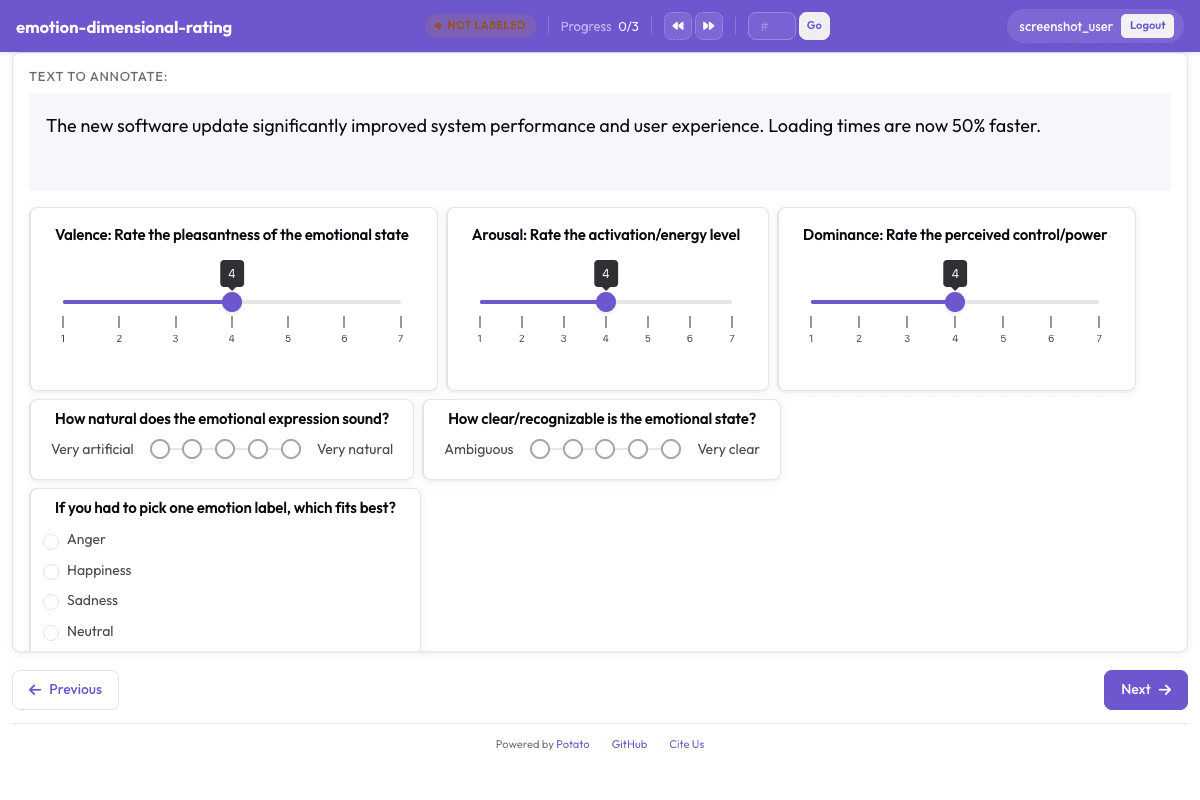
Configuration File
yaml
annotation_task_name: "Continuous Emotion Rating"
task_dir: "."

port: 8000

# Data configuration
data_files:
  - "data/speech_utterances.json"

item_properties:
  id_key: id
  text_key: text
instance_display:
  fields:
    - key: audio_url
      type: audio
      label: "Utterance"
    - key: text
      type: text
      label: "Transcript"

# Annotation schemes
annotation_schemes:
  # Valence (pleasure dimension)
  - annotation_type: slider
    name: valence
    description: "Valence: rate the pleasantness of the emotional state. 1 is very negative (unhappy, annoyed, dissatisfied), 7 is very positive (happy, pleased, satisfied)."
    min_value: 1
    max_value: 7
    step: 0.1
    starting_value: 4

  # Arousal (activation dimension)
  - annotation_type: slider
    name: arousal
    description: "Arousal: rate the activation/energy level. 1 is very calm (relaxed, sleepy, bored), 7 is very activated (excited, alert, energetic)."
    min_value: 1
    max_value: 7
    step: 0.1
    starting_value: 4

  # Dominance (control dimension)
  - annotation_type: slider
    name: dominance
    description: "Dominance: rate the perceived control/power. 1 is submissive (controlled, influenced), 7 is dominant (controlling, influential)."
    min_value: 1
    max_value: 7
    step: 0.1
    starting_value: 4

  # Naturalness
  - annotation_type: likert
    name: naturalness
    description: "How natural does the emotional expression sound?"
    size: 5
    min_label: "Very artificial"
    max_label: "Very natural"

  # Emotion clarity
  - annotation_type: likert
    name: clarity
    description: "How clear/recognizable is the emotional state?"
    size: 5
    min_label: "Ambiguous"
    max_label: "Very clear"

  # Primary emotion (optional categorical backup)
  - annotation_type: radio
    name: primary_emotion
    description: "If you had to pick one emotion label, which fits best?"
    labels:
      - Anger
      - Happiness
      - Sadness
      - Neutral
      - Fear
      - Surprise
      - Contempt
      - Mixed/unclear
    required: false

# User settings
require_password: false

# Output
output_annotation_dir: "annotation_output/"
export_annotation_format: "jsonl"
Sample Data
json
[
  {
    "id": "emotion_dimensional_rating_1",
    "audio_url": "https://upload.wikimedia.org/wikipedia/commons/5/58/En-us-I%27m_in_love_with_you.oga",
    "text": "I'm in love with you."
  },
  {
    "id": "emotion_dimensional_rating_2",
    "audio_url": "https://upload.wikimedia.org/wikipedia/commons/9/9d/En-us-I_know_you_are_but_what_am_I.ogg",
    "text": "I know you are, but what am I?"
  }
]

// ... and 3 more items
Get This Design
This design is available in our showcase. Copy the configuration below to get started.
Quick start:
bash
# Create your project folder
mkdir emotion-dimensional-rating
cd emotion-dimensional-rating
# Save config.yaml from this page into this folder
potato start config.yaml
Details
Annotation Types
sliderlikert
Domain
AudioSpeech
Use Cases
emotion ratingdimensional emotionaffective computing
Tags
audioemotiondimensionalvalencearousal
Related Designs
Audio Transcription Review
Review and correct automatic speech recognition transcriptions with waveform visualization.
likertmultiselect
Audio-Visual Sentiment Analysis
Rate sentiment in speech segments following CMU-MOSI and CMU-MOSEI multimodal annotation protocols.
likertradio
LibriSpeech - Audio Transcription and Quality Rating
Audio transcription quality assessment based on the LibriSpeech corpus (Panayotov et al., ICASSP 2015). Annotators rate audio quality using a slider and classify audio segments by content type, supporting speech recognition research and dataset curation.
slideraudio_annotation